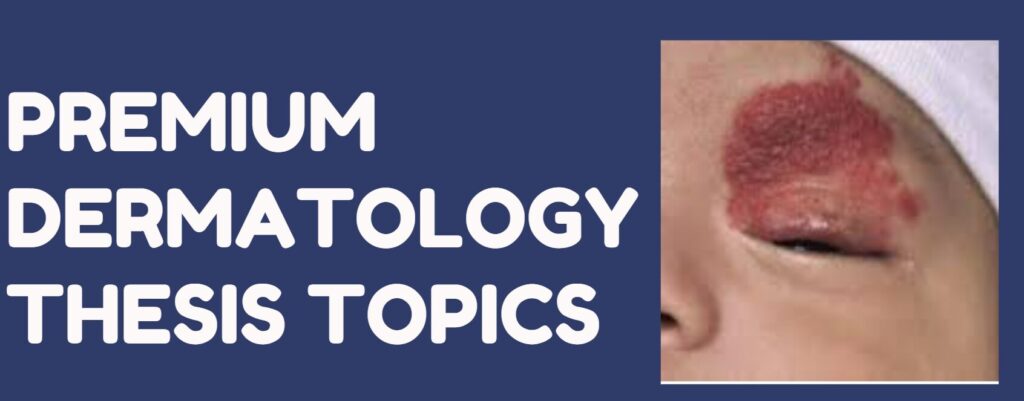
DERMATOLOGY THESIS TOPICS FOR MD/DNB

dermatology-thesis-topics

DERMATOLOGY THESIS TOPICS

Below is the current list of 100 free dermatology thesis topics for MD and DNB candidates in Dermatology, Venereology and Leprosy. Each title uses a cross-sectional, observational, dermoscopic or comparative design that a postgraduate can complete from patients already attending the skin outpatient department and sexually transmitted infection clinic, without prospective follow-up. Every topic generates a complete dermatology protocol and dermatology synopsis in editable format. For more topics you can avail the service of premium Dermatology thesis topics.

Last reviewed and updated: August 2026

📌 Updated for 2026–2027 MD Dermatology admissions

This dermatology thesis topic list is updated for the 2026–27 academic cycle. Topics are reviewed against recent dissertations, examiner preferences, feasibility in Indian medical colleges, and publication trends in dermatology, venereology and leprosy.

  • Designs that avoid prospective follow-up and fit within postgraduate timelines
  • Topics achievable with clinical examination, dermoscopy, routine investigations and outpatient case material
  • Options with strong potential for publication
Generate a protocol from any topic below

Select Generate Protocol → beside any title and receive a submission-ready document built around that topic, containing all eighteen components:

  • Introduction / Synopsis
  • Research Question
  • Aim of the Study
  • Primary Objective
  • Secondary Objectives
  • Materials and Methods
  • Inclusion Criteria
  • Exclusion Criteria
  • Sample Size Calculation
  • Methodology
  • Statistical Analysis
  • Ethical Considerations
  • Review of Literature
  • References
  • Gantt Chart / Study Timeline
  • Patient Information Sheet
  • Consent Form
  • Data Collection Form

Acne and Acne-Related Disorders

  1. Clinical and Epidemiological Profile of Acne Vulgaris among Patients Attending a Dermatology Outpatient Department: A Cross-Sectional Observational Study
  2. Association of Body Mass Index with Clinical Severity of Acne Vulgaris among Young Adults: A Cross-Sectional Analytical Study
  3. Association of Dietary Patterns with Severity of Acne Vulgaris among Adolescents and Young Adults: A Cross-Sectional Study
  4. Comparative Assessment of Acne Severity among Patients with Oily and Non-Oily Skin Types: A Cross-Sectional Study
  5. Association of Psychological Stress with Severity of Acne Vulgaris among Medical Students: A Cross-Sectional Analytical Study
  6. Prevalence and Clinical Pattern of Post-Acne Scarring among Patients with Acne Vulgaris: A Cross-Sectional Observational Study
  7. Association of Acne Severity with Quality of Life among Adolescents and Young Adults: A Cross-Sectional Analytical Study
  8. Comparative Evaluation of Clinical Characteristics of Adolescent and Adult-Onset Acne Vulgaris: A Cross-Sectional Study
  9. Association of Menstrual Irregularities and Clinical Features of Hyperandrogenism with Acne Severity among Women: A Cross-Sectional Analytical Study
  10. Clinical Profile and Pattern of Acne Excoriée among Patients Attending a Dermatology Outpatient Department: A Cross-Sectional Observational Study

Psoriasis Thesis Topics

  1. Clinical and Epidemiological Profile of Patients with Psoriasis Attending a Tertiary Care Hospital: A Cross-Sectional Observational Study
  2. Prevalence of Metabolic Syndrome among Patients with Chronic Plaque Psoriasis: A Cross-Sectional Study
  3. Association of Body Mass Index with Severity of Chronic Plaque Psoriasis: A Cross-Sectional Analytical Study
  4. Comparative Evaluation of Lipid Profile in Patients with Psoriasis and Age- and Sex-Matched Controls: A Cross-Sectional Study
  5. Association of Serum Uric Acid Levels with Severity of Psoriasis: A Cross-Sectional Analytical Study
  6. Prevalence and Pattern of Nail Changes among Patients with Psoriasis: A Cross-Sectional Observational Study
  7. Association of Nail Involvement with Severity of Cutaneous Psoriasis: A Cross-Sectional Analytical Study
  8. Comparative Assessment of Cardiometabolic Risk Factors among Patients with Mild and Moderate-to-Severe Psoriasis: A Cross-Sectional Study
  9. Association of Psoriasis Severity with Dermatology-Specific Quality of Life among Adult Patients: A Cross-Sectional Analytical Study
  10. Prevalence and Clinical Characteristics of Psoriatic Arthritis among Patients with Cutaneous Psoriasis: A Cross-Sectional Study

Alopecia and Hair Disorders

  1. Clinical and Dermoscopic Profile of Patients with Alopecia Areata: A Cross-Sectional Observational Study
  2. Association of Thyroid Dysfunction with Alopecia Areata among Adult Patients: A Cross-Sectional Analytical Study
  3. Comparative Evaluation of Serum Vitamin D Levels in Patients with Alopecia Areata and Healthy Controls: A Cross-Sectional Study
  4. Association of Clinical Severity of Alopecia Areata with Dermoscopic Findings: A Cross-Sectional Analytical Study
  5. Clinical and Dermoscopic Profile of Androgenetic Alopecia among Adult Males: A Cross-Sectional Observational Study
  6. Comparative Assessment of Dermoscopic Findings in Androgenetic Alopecia and Telogen Effluvium: A Cross-Sectional Study
  7. Clinical and Aetiological Profile of Diffuse Hair Loss among Women Attending a Dermatology Outpatient Department: A Cross-Sectional Observational Study
  8. Association of Serum Ferritin Levels with Diffuse Hair Loss among Women: A Cross-Sectional Analytical Study
  9. Comparative Evaluation of Haematological and Thyroid Parameters in Women with and without Diffuse Hair Loss: A Cross-Sectional Study
  10. Clinical and Dermoscopic Spectrum of Non-Scarring Alopecia among Patients Attending a Tertiary Care Hospital: A Cross-Sectional Study

Sexually Transmitted Infections and Venereology

  1. Clinical and Epidemiological Profile of Sexually Transmitted Infections among Patients Attending a Sexually Transmitted Infection Clinic: A Cross-Sectional Observational Study
  2. Pattern of Genital Ulcerative Diseases among Patients Attending a Tertiary Care Hospital: A Cross-Sectional Study
  3. Clinical Profile and Associated Risk Factors of Genital Warts among Adult Patients: A Cross-Sectional Observational Study
  4. Seroprevalence of Human Immunodeficiency Virus Infection among Patients with Sexually Transmitted Infections: A Cross-Sectional Study
  5. Comparative Evaluation of Sexually Transmitted Infection Patterns among Male and Female Patients: A Cross-Sectional Study
  6. Clinical and Serological Profile of Syphilis among Patients Attending a Sexually Transmitted Infection Clinic: A Cross-Sectional Observational Study
  7. Prevalence of Hepatitis B and Hepatitis C Seropositivity among Patients with Sexually Transmitted Infections: A Cross-Sectional Study
  8. Association of High-Risk Sexual Behaviours with Pattern of Sexually Transmitted Infections among Adult Patients: A Cross-Sectional Analytical Study
  9. Clinical and Aetiological Profile of Genital Discharge Syndromes among Patients Attending a Sexually Transmitted Infection Clinic: A Cross-Sectional Observational Study
  10. Assessment of Knowledge, Attitudes and Preventive Practices Regarding Sexually Transmitted Infections among College Students: A Cross-Sectional Study

Autoimmune and Connective Tissue Disorders

  1. Clinical and Cutaneous Profile of Patients with Systemic Lupus Erythematosus: A Cross-Sectional Observational Study
  2. Association of Cutaneous Manifestations with Selected Immunological Parameters in Systemic Lupus Erythematosus: A Cross-Sectional Analytical Study
  3. Clinical and Dermoscopic Profile of Cutaneous Lupus Erythematosus: A Cross-Sectional Study
  4. Comparative Evaluation of Cutaneous Manifestations in Systemic and Cutaneous Lupus Erythematosus: A Cross-Sectional Study
  5. Clinical Profile of Cutaneous Manifestations among Patients with Systemic Sclerosis: A Cross-Sectional Observational Study
  6. Association of Nailfold Capillaroscopic Abnormalities with Clinical Manifestations in Systemic Sclerosis: A Cross-Sectional Analytical Study
  7. Clinical and Cutaneous Profile of Patients with Dermatomyositis Presenting to a Tertiary Care Hospital: A Cross-Sectional Observational Study
  8. Comparative Evaluation of Cutaneous Findings among Different Autoimmune Connective Tissue Disorders: A Cross-Sectional Study
  9. Prevalence and Pattern of Oral Mucosal Manifestations among Patients with Autoimmune Connective Tissue Disorders: A Cross-Sectional Study
  10. Association of Dermatology-Specific Quality of Life with Severity of Cutaneous Manifestations in Autoimmune Connective Tissue Disorders: A Cross-Sectional Analytical Study

Vesiculobullous and Blistering Disorders

  1. Clinical and Histopathological Profile of Autoimmune Vesiculobullous Disorders at a Tertiary Care Hospital: A Cross-Sectional Observational Study
  2. Comparative Evaluation of Clinical and Immunofluorescence Findings in Pemphigus Vulgaris and Bullous Pemphigoid: A Cross-Sectional Study
  3. Clinical Profile and Distribution of Mucocutaneous Lesions among Patients with Pemphigus Vulgaris: A Cross-Sectional Observational Study
  4. Association of Extent of Cutaneous Involvement with Mucosal Involvement in Pemphigus Vulgaris: A Cross-Sectional Analytical Study
  5. Clinical and Immunopathological Profile of Bullous Pemphigoid among Patients Attending a Tertiary Care Hospital: A Cross-Sectional Study
  6. Comparative Evaluation of Age, Clinical Pattern and Distribution of Lesions in Pemphigus Vulgaris and Bullous Pemphigoid: A Cross-Sectional Study
  7. Correlation of Clinical Diagnosis with Histopathology and Direct Immunofluorescence in Autoimmune Vesiculobullous Disorders: A Cross-Sectional Analytical Study
  8. Spectrum of Autoimmune Vesiculobullous Disorders Diagnosed by Direct Immunofluorescence: A Cross-Sectional Observational Study
  9. Clinical and Histopathological Profile of Dermatitis Herpetiformis among Patients Presenting with Vesiculobullous Lesions: A Cross-Sectional Study
  10. Comparative Assessment of Oral Mucosal Involvement among Different Autoimmune Vesiculobullous Disorders: A Cross-Sectional Study

Papulosquamous and Scaling Disorders

  1. Clinical and Epidemiological Spectrum of Papulosquamous Disorders among Patients Attending a Dermatology Outpatient Department: A Cross-Sectional Observational Study
  2. Comparative Evaluation of Clinical and Dermoscopic Findings in Psoriasis and Lichen Planus: A Cross-Sectional Study
  3. Clinical and Dermoscopic Profile of Lichen Planus among Adult Patients: A Cross-Sectional Observational Study
  4. Association of Clinical Variants of Lichen Planus with Mucosal and Nail Involvement: A Cross-Sectional Analytical Study
  5. Clinical and Dermoscopic Profile of Pityriasis Rosea among Patients Attending a Tertiary Care Hospital: A Cross-Sectional Study
  6. Comparative Evaluation of Clinical and Histopathological Findings in Common Papulosquamous Disorders: A Cross-Sectional Study
  7. Clinical Profile of Palmoplantar Keratoderma among Patients Attending a Dermatology Outpatient Department: A Cross-Sectional Observational Study
  8. Spectrum of Scalp Scaling Disorders and Their Dermoscopic Characteristics: A Cross-Sectional Study
  9. Comparative Dermoscopic Evaluation of Scalp Psoriasis and Seborrhoeic Dermatitis: A Cross-Sectional Study
  10. Association of Papulosquamous Skin Disease Severity with Dermatology-Specific Quality of Life: A Cross-Sectional Analytical Study

Skin Infections and Infestations

  1. Clinical and Mycological Profile of Dermatophytosis among Patients Attending a Dermatology Outpatient Department: A Cross-Sectional Study
  2. Association of Topical Corticosteroid Use with Clinical Pattern of Dermatophytosis: A Cross-Sectional Analytical Study
  3. Comparative Evaluation of Direct Microscopy and Fungal Culture in Patients with Clinically Suspected Dermatophytosis: A Cross-Sectional Study
  4. Clinical and Mycological Profile of Recurrent and Chronic Dermatophytosis among Adult Patients: A Cross-Sectional Observational Study
  5. Prevalence and Associated Risk Factors of Scabies among Patients Attending a Dermatology Outpatient Department: A Cross-Sectional Study
  6. Comparative Evaluation of Clinical Characteristics of Scabies among Paediatric and Adult Patients: A Cross-Sectional Study
  7. Clinical and Bacteriological Profile of Pyoderma among Patients Attending a Tertiary Care Hospital: A Cross-Sectional Observational Study
  8. Bacterial Profile and Antimicrobial Susceptibility Pattern of Isolates from Patients with Pyoderma: A Cross-Sectional Study
  9. Clinical Profile and Associated Risk Factors of Cutaneous Candidiasis among Patients Attending a Dermatology Department: A Cross-Sectional Observational Study
  10. Comparative Assessment of Cutaneous Fungal Infection Patterns among Patients with and without Type 2 Diabetes Mellitus: A Cross-Sectional Study

Pigmentary Disorders and Vitiligo

  1. Clinical and Epidemiological Profile of Vitiligo among Patients Attending a Tertiary Care Hospital: A Cross-Sectional Observational Study
  2. Association of Thyroid Dysfunction with Vitiligo among Adult Patients: A Cross-Sectional Analytical Study
  3. Comparative Evaluation of Serum Vitamin D Levels in Patients with Vitiligo and Healthy Controls: A Cross-Sectional Study
  4. Association of Extent of Vitiligo with Dermatology-Specific Quality of Life: A Cross-Sectional Analytical Study
  5. Clinical and Dermoscopic Profile of Different Types of Vitiligo: A Cross-Sectional Study
  6. Comparative Dermoscopic Evaluation of Vitiligo and Other Acquired Hypopigmentary Disorders: A Cross-Sectional Study
  7. Clinical and Epidemiological Profile of Melasma among Women Attending a Dermatology Outpatient Department: A Cross-Sectional Observational Study
  8. Association of Sun Exposure and Hormonal Factors with Clinical Severity of Melasma: A Cross-Sectional Analytical Study
  9. Comparative Assessment of Quality of Life among Patients with Vitiligo and Melasma: A Cross-Sectional Study
  10. Spectrum of Acquired Pigmentary Disorders among Patients Attending a Dermatology Outpatient Department: A Cross-Sectional Observational Study

Dermoscopy, Nail Disorders and Skin Manifestations of Systemic Disease

  1. Dermoscopic Patterns of Common Dermatological Disorders among Patients Attending a Tertiary Care Hospital: A Cross-Sectional Observational Study
  2. Correlation of Dermoscopic and Histopathological Findings in Common Pigmented Skin Lesions: A Cross-Sectional Analytical Study
  3. Clinical and Dermoscopic Profile of Nail Disorders among Patients Attending a Dermatology Outpatient Department: A Cross-Sectional Study
  4. Comparative Evaluation of Clinical and Dermoscopic Findings in Onychomycosis and Nail Psoriasis: A Cross-Sectional Study
  5. Clinical and Mycological Profile of Onychomycosis among Patients Attending a Tertiary Care Hospital: A Cross-Sectional Observational Study
  6. Comparative Assessment of Cutaneous Manifestations among Patients with Type 2 Diabetes Mellitus and Non-Diabetic Controls: A Cross-Sectional Study
  7. Association of Glycaemic Control with Pattern of Cutaneous Manifestations in Patients with Type 2 Diabetes Mellitus: A Cross-Sectional Analytical Study
  8. Prevalence and Pattern of Cutaneous Manifestations among Patients with Chronic Kidney Disease: A Cross-Sectional Study
  9. Comparative Evaluation of Cutaneous Manifestations across Different Stages of Chronic Kidney Disease: A Cross-Sectional Study
  10. Clinical Spectrum of Dermatological Manifestations among Patients with Chronic Liver Disease: A Cross-Sectional Observational Study

Subscribing to the premium thesis topics not only lets you browse the full premium list, it also gives you online guidance (guidance doesnt mean complete protocol) on synopsis writing, sample size calculation, inclusion and exclusion criteria, and support throughout thesis writing. If you do not subscribe, please still feel free to contact me for guidance.

Unlock Premium Dermatology Topics 🔒

Studying outside India?

The topics above work as research questions anywhere — what changes is the document your institution expects. Two different routes, depending on which applies to you.

Board residents — SCFHS, Arab Board, OMSB, KIMS, QCHP, NHRA, DHA and DOH

Dermatology residency across the Gulf carries a mandatory research requirement, and the equivalent of an Indian synopsis is the research proposal submitted to your IRB before a research project begins. The format differs from the Indian one: it additionally requires a Gantt chart, a budget and resources section, and a Declaration of Helsinki statement.

Generate a residency research proposal →

PhD and Master's candidates — Saudi Arabia, Malaysia, the Gulf and beyond

University graduate programmes generally require a full research proposal of roughly 6,000 to 10,000 words, with an extended literature review, a theoretical framework and a detailed methodology chapter — considerably longer and deeper than a residency proposal. These are written individually, by a medical doctor, with no artificial intelligence generation and no plagiarism, and revised until your supervisor accepts them.

Enquire about a PhD research proposal →

🔥 Trending research areas in Dermatology for 2026–27

Based on recent thesis submissions and examiner preferences in MD Dermatology departments across India, these are the emerging high-interest areas:

  • Dermoscopy as a diagnostic adjunct, including correlation with histopathology
  • Recurrent and steroid-modified dermatophytosis and its changing clinical pattern
  • Psoriasis as a systemic disease, with cardiometabolic and quality-of-life associations
  • Cutaneous manifestations of diabetes, chronic kidney disease and chronic liver disease

Protocol and synopsis guidance

What a dermatology protocol must contain

A dermatology protocol is judged on internal consistency: the research question, objectives, methodology and statistical plan must all describe the same study. The primary objective should be a single measurable endpoint — one severity association, one dermoscopic correlation, one profile — with everything else demoted to secondary objectives.

Severity in dermatology is almost always scored, so name the instrument with its version and state who applies it. Depending on the topic that means the Global Acne Grading System or the Investigator's Global Assessment for acne, the Psoriasis Area and Severity Index with the Body Surface Area and the Nail Psoriasis Severity Index, the Severity of Alopecia Tool for alopecia areata, the Vitiligo Area Scoring Index or the Vitiligo Extent Score, the Melasma Area and Severity Index, and the Pemphigus Disease Area Index or the Autoimmune Bullous Skin Disorder Intensity Score for blistering disease. Quality of life work should name the Dermatology Life Quality Index and confirm that a validated translation is being used where patients do not read English. Record the Fitzpatrick skin type, since severity scoring and dermoscopic appearances both vary with it.

Dermoscopy needs its own paragraph. State the dermatoscope make and model, whether polarised or non-polarised light is used and with what contact medium, the magnification, and how images are stored. Name the dermoscopic terminology framework you are applying so that findings are described in standard terms rather than ad hoc ones. Where dermoscopic findings are correlated with histopathology or mycology, state that the observer reading the dermoscopic images is blinded to that result, and that a second observer reads a defined subset so agreement can be reported.

Inclusion and exclusion criteria are written for patients and must address treatment status explicitly, because it alters the clinical picture: exclude patients on systemic or topical therapy for the condition within a stated washout period, and for dermatophytosis record prior topical corticosteroid use rather than ignoring it. For mycological work, state the specimen collection site and method, the potassium hydroxide concentration used for direct microscopy, the culture medium and the incubation period.

Dermatology synopsis versus dermatology protocol

A dermatology synopsis is the condensed document of two to four pages — title, introduction, aim and objectives, brief methodology, sample size and references — submitted for registration of the dissertation topic. The dermatology protocol is the expanded version of twelve to twenty pages carrying the full review of literature, detailed methodology including severity scores, dermoscopic technique and observer arrangements, statistical plan, study timeline and annexures including the patient information sheet, consent form, a separate consent for clinical photography, and a copy of any severity or quality-of-life instrument used.

In practice the synopsis is extracted from the protocol rather than written separately, which is faster and produces a more coherent document. Check your university's prescribed proforma before submission, since rejections on formatting grounds are common and entirely avoidable.

Sample size and statistical analysis

Prevalence studies — metabolic syndrome in psoriasis, nail changes, thyroid dysfunction in vitiligo — use a proportion-based calculation from a comparable published series, with the desired absolute precision and confidence level, citing the source. Association studies between a severity score and another variable use the expected correlation coefficient. Case-control comparisons of a laboratory parameter use the difference in means with the standard deviation from prior literature, and the matching criteria must be stated where controls are described as age- and sex-matched. Diagnostic comparisons such as direct microscopy against culture, or dermoscopy against histopathology, need a calculation based on expected sensitivity or specificity together with the expected prevalence of the finding.

Name the tests rather than promising that data will be analysed. Severity scores are frequently skewed, so state the normality test that decides between the independent t-test and the Mann-Whitney U test, and report medians with interquartile ranges where the distribution is skewed. Comparison across three or more severity grades calls for analysis of variance or the Kruskal-Wallis test with a post-hoc comparison. Correlation between two scores uses the Pearson or Spearman coefficient, with Spearman preferred where one variable is an ordered grade rather than a continuous measure. Proportions are compared with the chi-squared test using Fisher's exact test for small cells. Diagnostic comparisons report sensitivity, specificity, predictive values and accuracy with confidence intervals against a stated reference standard, and agreement between observers or methods as a kappa statistic.

Frequently Asked Questions – Dermatology Thesis Topics (2026–27)

1. How do I choose a feasible dermatology thesis topic for the 2026–27 academic year?

Start with your outpatient register. Count how many patients with your chosen condition attended over the last twelve months. Acne, dermatophytosis, psoriasis, vitiligo and hair loss accrue readily in almost every department; pemphigus, dermatitis herpetiformis, systemic sclerosis and dermatomyositis do not, and a study needing sixty patients with an uncommon disorder is better designed with a retrospective arm on departmental records.

Then check the extras. Direct immunofluorescence, mycological culture, capillaroscopy and immunological panels depend on another department or on funding. A dermatoscope with photographic capability is essential for a third of the topics above, so confirm you have reliable access rather than borrowing one occasionally. Finally, confirm the gap: clinicoepidemiological profile studies of acne and dermatophytosis are heavily published in India, so your question needs a comparison or association that comparable centres have not already reported.

2. Which study designs are commonly accepted for MD Dermatology theses?

Cross-sectional observational and analytical designs account for the large majority of accepted dermatology dissertations. Clinicoepidemiological profile studies of a defined condition, association studies between disease severity and a systemic or laboratory parameter, dermoscopic pattern studies, correlation of clinical with dermoscopic or histopathological findings, and quality-of-life studies are all well established.

Case-control comparisons against healthy controls are accepted where the matching is clearly defined. Randomised comparisons of two treatments are undertaken occasionally but need substantially more time and regulatory work than a three-year course usually allows, and any interventional design will attract closer ethical scrutiny.

3. What should I discuss with my guide before finalising a Dermatology thesis topic?

Bring three to five shortlisted titles rather than one, since guides frequently rule out a topic on grounds you could not have known — an ongoing departmental study, a reagent or stain not currently supplied, a case category that has thinned out.

Settle four things in that meeting: outpatient volume in your condition, which investigations are needed beyond routine and who funds them, dermatoscope access and who will provide the second independent reader, and which journal the eventual paper is aimed at.

4. Can a dermatology thesis be completed without biopsy or laboratory investigations?

Yes, and a large share are. Clinicoepidemiological profiling, severity scoring, dermoscopic pattern studies, quality-of-life assessment and questionnaire-based knowledge and practice studies all rely on clinical examination and validated instruments alone. Where a laboratory value is needed, using results already ordered clinically rather than taking research-specific samples is both easier to justify and faster to clear ethics.

5. What is the difference between a dermatology synopsis and a protocol?

The synopsis is the condensed two to four page document submitted for topic registration. The protocol is the full document of twelve to twenty pages containing the detailed review of literature, methodology with severity scores and dermoscopic technique, statistical plan, timeline and annexures — including a separate photography consent and a copy of any instrument used. The synopsis is normally extracted from the completed protocol.

6. What ethical clearance does a dermatology dissertation need?

Full institutional ethics committee approval before any data collection, with written informed consent from every patient. Two elements need particular attention in this speciality. Clinical and dermoscopic photography requires its own consent, stating where images will be stored, how the patient will be de-identified, and whether images may be used in publication or teaching — and consent must be obtainable separately for each of those uses. Studies at a sexually transmitted infection clinic or involving human immunodeficiency virus testing require explicit safeguards on confidentiality, counselling and how results are communicated, and the protocol should state that participation does not affect the care received. Studies recruiting adolescents need parental consent with assent. Clearance commonly takes six to ten weeks and retrospective approval is not granted.

7. Which severity scores and quality-of-life instruments should I name?

Name the specific instrument rather than referring vaguely to severity assessment. Common choices are the Global Acne Grading System, the Psoriasis Area and Severity Index with the Nail Psoriasis Severity Index, the Severity of Alopecia Tool, the Vitiligo Area Scoring Index, the Melasma Area and Severity Index, and the Dermatology Life Quality Index for quality of life. Three things must then be stated: who applies the score and whether they are trained in it, whether any licence or permission is needed for use, and that a validated translation is being used where patients do not read English. Translating an instrument verbally at the bedside invalidates it, and examiners in this speciality do ask. Annex a copy of the version used to the protocol.

8. Is a PhD research proposal different from an MD synopsis?

Substantially. A PhD proposal typically runs 6,000 to 10,000 words and carries an extended critical literature review, a theoretical framework, a detailed methodology chapter and a discussion of expected contribution to the field. An MD synopsis is a two to four page registration document. The research question can be the same; the depth expected is not.

9. When should I register my dermatology thesis topic?

Most universities require registration within six to nine months of joining. Shortlist in the first two months, finalise with your guide by the third, and file for ethics clearance immediately afterwards. Where pathology or microbiology must supply your reference standard, secure that cooperation in writing at the same time, and obtain any licence needed for a severity or quality-of-life instrument before submission rather than after.

Found a topic that fits your department?

Generate its full protocol — objectives, methodology, sample size, statistics, timeline, references and annexures — in editable format.

Generate your protocol
Don`t copy text!
Generate Thesis Protocol / Synopsis
×