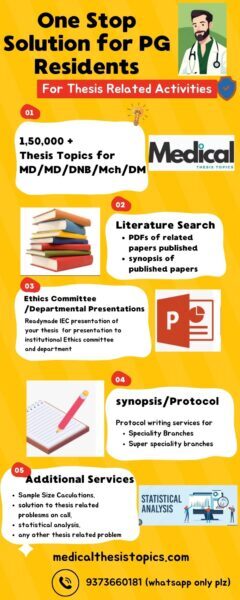
Below is the current list of 100 free paediatrics thesis topics for MD and DNB candidates. Each title uses a cross-sectional, observational, comparative or record-based design that a postgraduate can complete from children already attending the paediatric wards, outpatient department, neonatal unit and emergency room, without prospective follow-up. Every topic generates a complete paediatrics protocol and paediatrics synopsis in editable format. For more topics you can avail the service of premium Paediatrics thesis topics.
Last reviewed and updated: August 2026
📌 Updated for 2026–2027 MD Paediatrics admissions
This paediatrics thesis topic list is updated for the 2026–27 academic cycle. Topics are reviewed against recent dissertations, examiner preferences, feasibility in Indian medical colleges, and publication trends in paediatrics.
Select Generate Protocol → beside any title and receive a submission-ready document built around that topic, containing all eighteen components:
Subscribing to the premium thesis topics not only lets you browse the full premium list, it also gives you online guidance (guidance doesnt mean complete protocol) on synopsis writing, sample size calculation, inclusion and exclusion criteria, and support throughout thesis writing. If you do not subscribe, please still feel free to contact me for guidance.
Unlock Premium Paediatrics Topics 🔒Studying outside India?
The topics above work as research questions anywhere — what changes is the document your institution expects. Two different routes, depending on which applies to you.
Board residents — SCFHS, Arab Board, OMSB, KIMS, QCHP, NHRA, DHA and DOH
Paediatric residency across the Gulf carries a mandatory research requirement, and the equivalent of an Indian synopsis is the research proposal submitted to your IRB before a research project begins. The format differs from the Indian one: it additionally requires a Gantt chart, a budget and resources section, and a Declaration of Helsinki statement.
Generate a residency research proposal →PhD and Master's candidates — Saudi Arabia, Malaysia, the Gulf and beyond
University graduate programmes generally require a full research proposal of roughly 6,000 to 10,000 words, with an extended literature review, a theoretical framework and a detailed methodology chapter — considerably longer and deeper than a residency proposal. These are written individually, by a medical doctor, with no artificial intelligence generation and no plagiarism, and revised until your supervisor accepts them.
Enquire about a PhD research proposal →🔥 Trending research areas in Paediatrics for 2026–27
Based on recent thesis submissions and examiner preferences in MD Paediatrics departments across India, these are the emerging high-interest areas:
A paediatrics protocol is judged on internal consistency: the research question, objectives, methodology and statistical plan must all describe the same study. The primary objective should be a single measurable endpoint — one prevalence, one association, one comparison — with everything else demoted to secondary objectives.
Age bands must be defined operationally rather than assumed. State exactly what you mean by neonate, early and late neonatal period, infant, under-five, school-age and adolescent, and give the age range in completed months or years. In neonatal work, state how gestational age is determined — last menstrual period, early ultrasonography or the New Ballard score — and which takes precedence when they disagree, because the entire preterm-versus-term comparison rests on it.
Name every growth reference, classification and scoring system with its version. Anthropometry should specify the World Health Organization growth standards or the Indian Academy of Paediatrics charts, that results are expressed as z-scores, and how the measurements are taken and by whom. Severe acute malnutrition needs the weight-for-height z-score, mid-upper arm circumference cut-off and oedema criteria stated explicitly. Other systems to name where relevant include the World Health Organization pneumonia classification, the ILAE seizure and epilepsy classification, the ILAR criteria for juvenile idiopathic arthritis, the World Health Organization dengue case classification, the standard definitions for nephrotic syndrome and its relapse, KDIGO staging adapted for children, and the Paediatric Risk of Mortality score with the version used. For development, name the assessment tool — a locally validated developmental screening instrument — and state who administers it and whether they are trained in its use.
Inclusion and exclusion criteria are written for children: exclude known syndromic or chromosomal disorders where they confound growth, children already on treatment that alters the parameter under study, and neonates with major congenital malformations where these are outside the study focus.
A paediatrics synopsis is the condensed document of two to four pages — title, introduction, aim and objectives, brief methodology, sample size and references — submitted for registration of the dissertation topic. The paediatrics protocol is the expanded version of twelve to twenty pages carrying the full review of literature, detailed methodology including age definitions, growth references and classification systems, statistical plan, study timeline and annexures including the parent information sheet, consent form, assent form and data collection proforma.
Note the annexure count: paediatric protocols need both a consent form for the parent or guardian and a separate, simply worded assent form for the child. Submitting only one is a common reason these protocols are returned. In practice the synopsis is extracted from the protocol rather than written separately, and you should check your university's prescribed proforma before submission.
Prevalence studies — undernutrition, developmental delay, anaemia, congenital heart disease — use a proportion-based calculation from the figure reported in a comparable published study, with the desired absolute precision and confidence level, citing the source. Comparative studies of a measured parameter between two groups use the difference in means with the standard deviation from prior literature, and correlation studies use the expected correlation coefficient. Where a marker such as serum lactate or a mortality score is assessed for a cut-off, base the calculation on expected sensitivity or specificity together with the expected prevalence of the outcome.
State admission or attendance volume explicitly, and be realistic about seasonality. A study of scrub typhus or dengue in children depends on a transmission season that may fall only once within your data collection window, and a study needing eighty children with a specific condition from a unit admitting three a month will not accrue. This is the first question at scrutiny.
Name the tests rather than promising that data will be analysed. Anthropometric outcomes should be analysed as z-scores rather than raw measurements, since raw weight and height are meaningless without adjustment for age and sex. Comparison between two groups uses the independent t-test or the Mann-Whitney U test with a stated normality test; three or more groups call for analysis of variance or the Kruskal-Wallis test with a post-hoc comparison; proportions are compared with the chi-squared test using Fisher's exact test for small cells. Correlation uses the Pearson or Spearman coefficient, and where several factors are assessed against an outcome, name multivariable logistic regression to handle confounding by age and nutritional status.
Start with your admission register and pay attention to seasonality. Count how many children with your chosen condition were admitted over the last twelve months, and check when in the year they came. Neonatal sepsis, undernutrition, pneumonia and anaemia accrue steadily; dengue, scrub typhus and bronchiolitis cluster into a few months, so a study depending on them may only get one season within your collection window.
Then check what the study needs beyond routine care. Echocardiography, spirometry in young children, electroencephalography and specialised assays depend on another department and often on funding. Finally, confirm the gap: clinical profile studies of neonatal sepsis and undernutrition are heavily published in India, so your question needs a comparison or population that comparable centres have not already reported.
Cross-sectional observational and analytical designs account for the large majority of accepted paediatric dissertations. Clinical and aetiological profile studies of a defined condition, prevalence studies within a defined child population, association studies between a marker or exposure and disease severity, and comparative designs contrasting two groups of children are all well established.
Community and school-based prevalence surveys form a further stream and are well regarded, though they need external permissions. Randomised trials in children are rarely feasible at postgraduate level, and designs requiring follow-up risk incomplete data once families stop attending.
Bring three to five shortlisted titles rather than one, since guides frequently rule out a topic on grounds you could not have known — an ongoing departmental study, a unit whose case mix has changed, an investigation no longer available in-house.
Settle four things in that meeting: annual admission volume and seasonality for your condition, which investigations are needed beyond routine and who funds them, how much additional blood sampling the ethics committee is likely to accept in children of that age, and which journal the eventual paper is aimed at.
Yes, and these are often the fastest to clear ethics. Anthropometric and nutritional assessment, developmental screening, questionnaire-based studies of feeding practices and screen time, clinical and echocardiographic profiling, and studies using only investigations already ordered clinically all avoid research-specific venepuncture entirely. Where a laboratory value is needed, using the result of a sample already drawn for clinical care rather than taking a fresh one is both more ethical and far easier to justify.
The synopsis is the condensed two to four page document submitted for topic registration. The protocol is the full document of twelve to twenty pages containing the detailed review of literature, methodology with age definitions, growth references and classification systems, statistical plan, timeline and annexures — including both a parental consent form and a separate child assent form. The synopsis is normally extracted from the completed protocol.
Written informed consent is taken from a parent or legal guardian for every child recruited. In addition, written assent is obtained from the child where age and understanding permit — national ethical guidance expects assent from children of around seven years and above, with the assent document written in simple language the child can follow. State in the protocol the age at which assent will be sought, who will explain the study to the child, and that a child's refusal is respected even where the parent has consented. Adolescents approaching adulthood should be given the information directly rather than through the parent alone. Both forms must be annexed to the protocol and provided in the local language.
This must be addressed explicitly, and it is where paediatric protocols most often run into difficulty. Ethics committees expect the research sample volume to be stated in millilitres, related to the child's body weight, and justified against national ethical guidance on permissible volumes for research in children, which are considerably more restrictive than in adults and tighter again in neonates and infants. State that no additional venepuncture will be performed where the required sample can be taken from blood already being drawn for clinical purposes, and that sampling is timed to coincide with clinically indicated tests. Where a study needs repeated samples, the cumulative volume over the study period must be stated, not just the volume per draw.
Substantially. A PhD proposal typically runs 6,000 to 10,000 words and carries an extended critical literature review, a theoretical framework, a detailed methodology chapter and a discussion of expected contribution to the field. An MD synopsis is a two to four page registration document. The research question can be the same; the depth expected is not.
Most universities require registration within six to nine months of joining. Shortlist in the first two months, finalise with your guide by the third, and file for ethics clearance immediately afterwards. Paediatric protocols attract closer ethical scrutiny than adult ones and may go through a second round of queries, so build that into your timeline. Where a school or community site must cooperate, secure permission in writing at the same time.
Found a topic that fits your department?
Generate its full protocol — objectives, methodology, sample size, statistics, timeline, references and annexures — in editable format.
Generate your protocol
© 2025 Medical Thesis Topics
© 2025 Medical Thesis Topics