
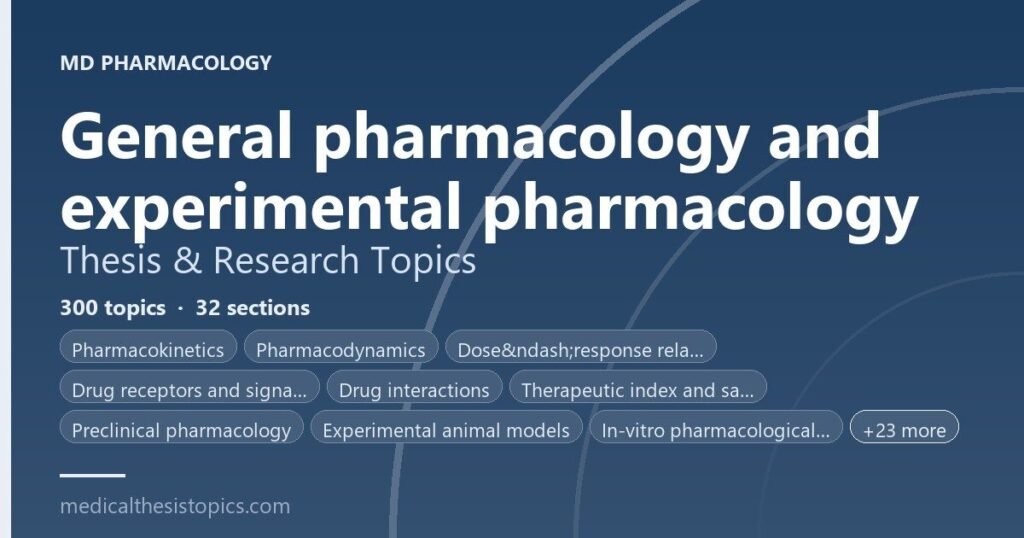
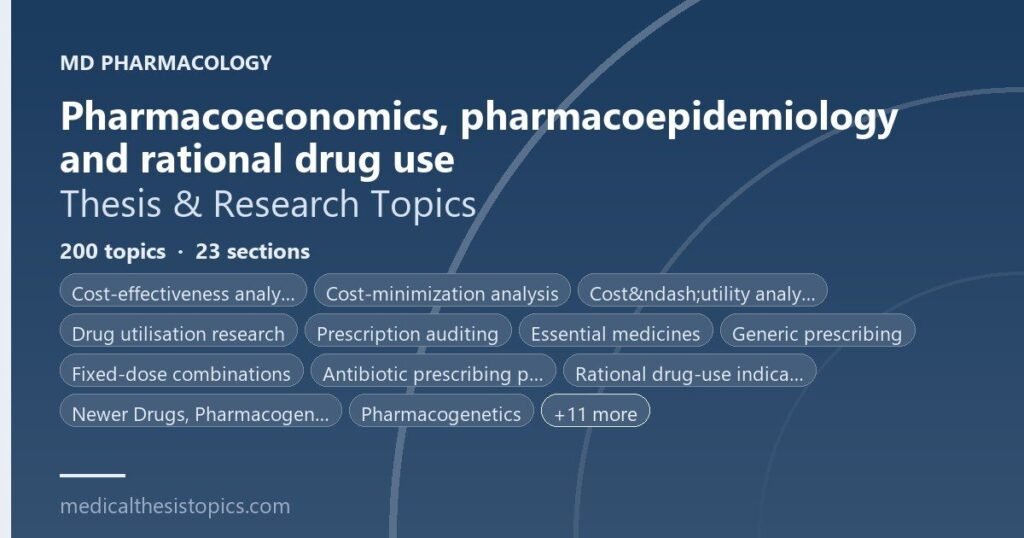
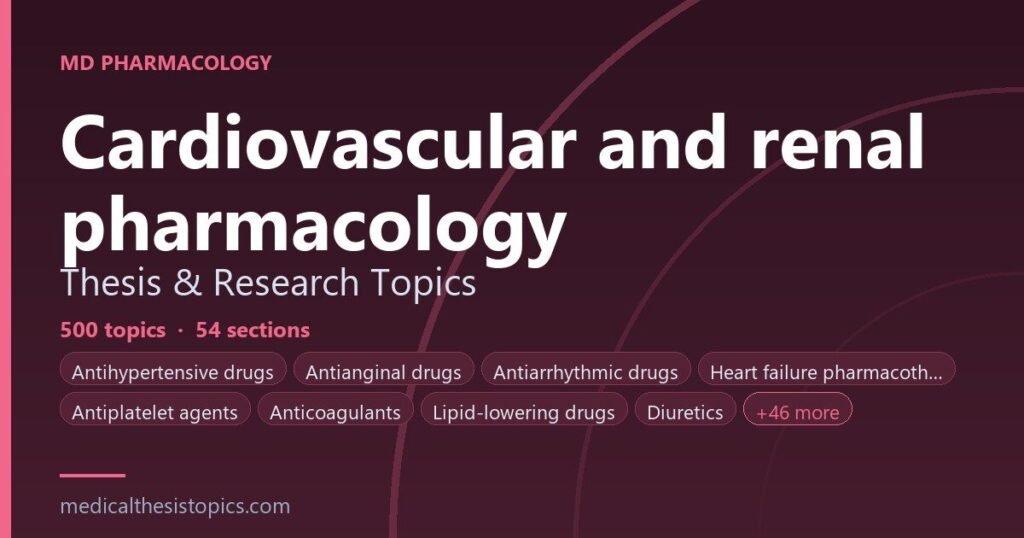
Free pharmacology thesis topics and pharmacology dissertation topics across the open sections in the tiles below — general and experimental pharmacology (pharmacokinetics, pharmacodynamics, dose–response relationships, drug receptors and signalling, drug interactions, therapeutic index and safety, preclinical pharmacology, experimental animal models and in-vitro methods), pharmacoeconomics, pharmacoepidemiology and rational drug use (cost-effectiveness, cost-minimisation and cost–utility analysis, drug utilisation research, prescription auditing, essential medicines, generic prescribing, fixed-dose combinations, antibiotic prescribing patterns, rational drug-use indicators and pharmacogenetics), cardiovascular and renal pharmacology (antihypertensive, antianginal and antiarrhythmic drugs, heart failure pharmacotherapy, antiplatelet agents, anticoagulants, lipid-lowering drugs and diuretics), cardiac pharmacology and psychopharmacology. Nothing is locked.
Whether you need MD pharmacology thesis topics, clinical pharmacology research topics, pharmacovigilance, pharmacoepidemiology and drug utilisation study topics, M.Pharm or MSc pharmacology dissertation topics, or a ready pharmacology thesis protocol, every title is written so it can be converted into a full synopsis with a defined study design, sample size and measurable outcome. Open any section and use the search box in its top right corner to jump to a specific area: type pharmacovigilance, prescribing pattern, antimicrobial stewardship, adherence or cost-effectiveness instead of scrolling.
The lists suit MD (Pharmacology) residents under MUHS, RGUHS, NTR UHS, MGR Medical University, KNRUHS and other Indian health universities, MSc Medical Pharmacology, M.Pharm and PharmD candidates, and Saudi Board, Arab Board, DHA, DOH, MOHAP, QCHP, HMC, OMSB, KIMS and NHRA trainees across the GCC carrying out drug-related research who need a research proposal rather than a thesis synopsis.



Pharmacology sits apart from the clinical specialities because the resident usually has no patients of their own. Your data has to come from someone else's ward, someone else's prescriptions, a laboratory bench, or a healthy volunteer — and each of those routes has a different gatekeeper. That is why topic selection in pharmacology is really a question about access: whose records can you read, whose department will collaborate, and what your institution's animal and ethics committees will actually clear inside your timeline.
The designs that finish reliably sit in pharmacoepidemiology and rational drug use: drug utilisation and prescription pattern studies using WHO and INRUD prescribing indicators or ATC/DDD methodology, pharmacovigilance and adverse drug reaction monitoring studies, medication adherence studies, pharmacoeconomic analyses of the cost-effectiveness, cost-minimisation or cost–utility type, antimicrobial stewardship and prescription audits, fixed-dose combination and generic prescribing audits against the essential medicines list, and knowledge-attitude-practice surveys among prescribers or patients. None of these need a bench, an animal house or a drug budget, and all of them produce publishable data from activity already happening in your hospital.
Once the title is fixed, the next step is the pharmacology thesis protocol — the synopsis in India, the research proposal in the Gulf. Both need the same core: background and rationale, review of literature, aims and objectives, study design, setting and duration, inclusion and exclusion criteria, a sample size calculation derived from a cited study, the data-collection instrument and any scales used, a statistical analysis plan, ethical considerations and consent, and Vancouver-style references. Pharmacology protocols must additionally name the methodology standard being followed — WHO core prescribing indicators, the WHO ATC/DDD index by year, the causality and severity scales for an ADR study, or the relevant animal ethics clearance — because a reviewer will ask which framework the analysis rests on.
Residents and clinical pharmacy trainees outside India face a different document. Instead of a university thesis synopsis, most GCC programmes require a research proposal approved by an institutional review board before data collection begins — an SCFHS research proposal in Saudi Arabia, a QCHP or HMC proposal in Qatar, a DHA, DOH or MOHAP-aligned proposal in the UAE, an OMSB proposal in Oman, a KIMS proposal in Kuwait, or an NHRA-aligned proposal in Bahrain. The research questions are identical to the ones listed in the sections above; what changes is the structure, with far more weight on feasibility, budget, timeline and data management, and far less on the historical review of literature.
Two things differ in practice. Gulf hospitals run mature electronic prescribing systems, which makes drug utilisation, prescribing pattern and stewardship studies far easier to extract and far harder to get released — expect a formal data access request alongside the IRB application, naming exactly which fields you will pull and how they will be de-identified. And pharmacovigilance work links into national reporting through bodies such as the Saudi Food and Drug Authority, so an ADR study should state how your reporting relates to the existing national system rather than running parallel to it.
Training outside India? Choose the path that matches your programme.
Board and residency trainees — Saudi Board, Arab Board, DHA, DOH, MOHAP, QCHP, HMC, OMSB, KIMS, NHRA:
Get a pharmacology research proposal for your board programme →
PhD and Master's candidates — university-registered research in pharmacology, clinical pharmacology, clinical pharmacy, pharmacovigilance or pharmacoeconomics:
Submit your PhD or Master's research topic →
The most dependable MD pharmacology thesis topics in India are drug utilisation and prescribing pattern studies in a defined department using WHO and INRUD indicators or ATC/DDD methodology; adverse drug reaction monitoring and pharmacovigilance studies in a ward, outpatient clinic or specific drug class; medication adherence studies using a validated scale; antimicrobial prescribing and stewardship audits; pharmacoeconomic cost-of-therapy comparisons; and knowledge-attitude-practice surveys among prescribers, nurses or patients. All of them run on activity already happening in your hospital and need no laboratory or drug budget.
Yes. Every section is open — the full topic lists are free to read, copy and discuss with your guide, with no subscription and no login required to see the topics.
Only with formal clearance, and only where your institution has a functioning animal house. Any experiment on animals requires approval from your Institutional Animal Ethics Committee, which operates under the national committee governing the control and supervision of experiments on animals, and the facility itself must be registered. Approval timelines are long, breeding and housing costs are real, and many departments have moved away from animal work toward simulation, in-vitro assays and human-participant designs. Confirm registration status, committee meeting frequency and funding before you build a thesis around it — this is the single most common reason a pharmacology protocol is abandoned halfway.
A drug utilisation study examines how drugs are actually prescribed, dispensed and used in a defined population — which agents, at what doses, for how long, in what combinations, and how closely that matches standard treatment guidelines or the essential medicines list. It is recommended because it needs no intervention, no recruitment and no laboratory: the prescriptions already exist. Methodology is well established through the WHO core prescribing indicators (average number of drugs per encounter, percentage prescribed by generic name, percentage with an antibiotic, percentage with an injection, percentage from the essential medicines list) and the ATC/DDD system for quantifying consumption. That combination of low feasibility risk and established methodology makes it the safest MD pharmacology thesis design.
Use a published, validated instrument and name it in the protocol. Causality is usually assessed with the WHO-UMC causality categories or the Naranjo algorithm, severity with the Hartwig and Siegel scale, preventability with the Schumock and Thornton criteria, and predictability by the Rawlins and Thompson classification. Many theses apply causality, severity and preventability together, which gives a much richer dataset than causality alone. State who will perform the assessment, whether independently by two assessors, and how disagreements will be resolved.
Prospective registration in the Clinical Trials Registry – India is required for interventional clinical trials, and is expected before enrolment of the first participant. Observational studies — drug utilisation, prescription audits, pharmacovigilance, adherence and KAP surveys — do not require it, although the registry does accept observational study registrations and many journals now look favourably on prospective registration regardless of design. If your study involves administering a drug, changing therapy, or randomising participants, treat registration as mandatory and build the timeline around it. Clinical trials additionally fall under the New Drugs and Clinical Trials Rules and may require regulatory permission beyond your ethics committee.
It depends on the design. Drug utilisation studies following WHO indicator methodology conventionally sample at least six hundred prescriptions for a cross-sectional assessment, or thirty per health facility in a multi-centre design, although a locally calculated figure is always stronger than a convention. Prevalence-type studies — the proportion of patients experiencing an adverse reaction, or the proportion adherent — size on the expected proportion from a cited study, an alpha of 0.05 and an absolute precision you set. Comparative studies size on the difference between groups. Whatever the design, the calculation and its source must appear in the protocol.
Yes. The research questions are the same; only the document format differs. An SCFHS-style research proposal for IRB submission is shorter than an Indian thesis synopsis and places more emphasis on feasibility, budget, timeline and data management. For drug utilisation and stewardship work in Gulf hospitals, add a data access plan naming the prescribing system fields you will extract and the de-identification method. Use the international link above to request that format.
Yes. Arab Board trainees, residents licensed under DHA, DOH and MOHAP in the UAE, QCHP and HMC residents in Qatar, OMSB residents in Oman, KIMS residents in Kuwait and NHRA-licensed trainees in Bahrain can all use these titles, as can clinical pharmacy and PharmD candidates carrying out drug-related research. What changes is the ethics and data-access pathway and the national pharmacovigilance system your reporting connects to — not the research question itself. Ethics committee approval before data collection is required everywhere, and data gathered before the approval date is generally not accepted.
© 2025 Medical Thesis Topics
© 2025 Medical Thesis Topics