
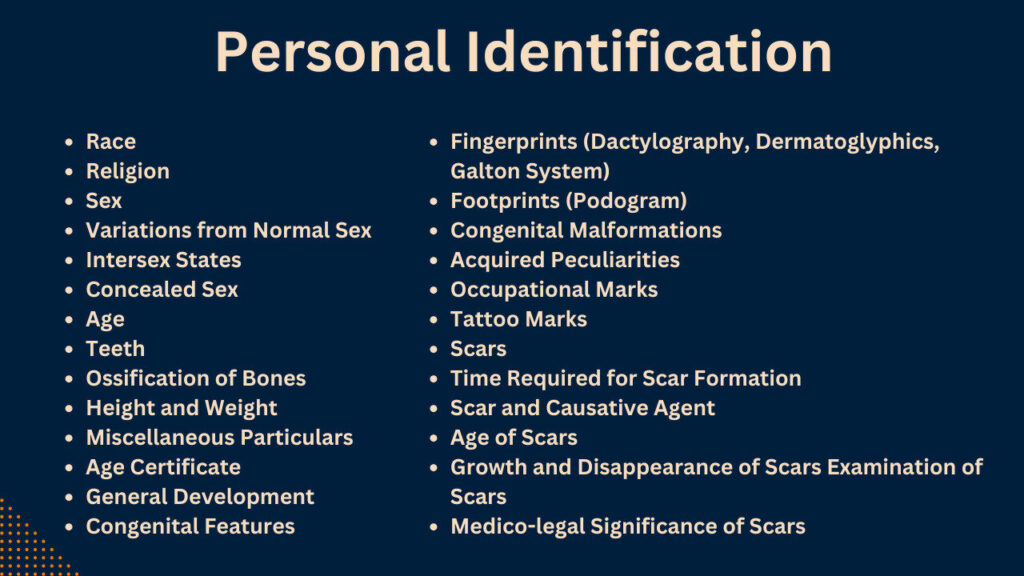
This page covers forensic medicine thesis topics on personal identification across ancestry-related morphological variation, sex and age estimation, dentition, ossification, stature, fingerprints, footprints, scars, tattoos, congenital and acquired peculiarities, occupational marks and integrated identification methods. The topics are intended for MD Forensic Medicine candidates and are designed around participants, medicolegal records, routine anthropometry, clinically available radiographs, dental findings and fingerprint or footprint examination that can generally be studied within one thesis period. The list also supports candidates searching for forensic medicine research topics on personal identification, while a structured personal identification protocol in forensic medicine or personal identification synopsis in forensic medicine can be developed once the target population, measurement method, reference standard and validation plan are fixed.
Last reviewed and updated: August 2026 · 2026–27 admissions
Population Ancestry and Morphological Variation
- Assessment of cranial index and its variation according to sex among adult patients attending a tertiary care teaching hospital in India: a hospital-based cross-sectional observational study.
- Comparison of cranial index between adult males and females for its utility in personal identification: a comparative cross-sectional study.
- Assessment of nasal index and its sexual variation among adults attending a tertiary care hospital: a cross-sectional observational study.
- Comparison of nasal index between adult males and females and evaluation of its usefulness for personal identification: a comparative cross-sectional study.
- Assessment of facial index among adult medical students and its variation according to sex: an institution-based cross-sectional study.
- Comparison of facial index between males and females in a defined Indian population: a comparative cross-sectional study.
- Relationship between cranial index and facial index among healthy adults: a cross-sectional analytical study.
- Assessment of morphological variation in external ear measurements among adults from different geographic regions of India studying at a medical college: a cross-sectional analytical study.
- Comparison of hand dimensions among adults originating from different geographic regions of India: a comparative cross-sectional study.
- Comparison of foot dimensions among adults from different geographic regions of India for application in personal identification: a comparative cross-sectional study.
- Assessment of cephalic dimensions among adults from different self-reported geographic backgrounds in a medical college population: a cross-sectional observational study.
- Comparison of facial anthropometric measurements among adults from different geographic regions of India: a comparative cross-sectional study.
- Association of self-reported geographic ancestry with selected craniofacial anthropometric measurements among adults: a cross-sectional analytical study.
- Comparison of nasal breadth and nasal height among adults from different geographic regions of India: a comparative cross-sectional study.
- Assessment of regional variation in anthropometric measurements of the external ear among adult students: a cross-sectional analytical study.
Religion and Personal Identification Records
- Completeness of documentation of religion in unidentified and identified deceased persons undergoing medicolegal autopsy: a record-based cross-sectional audit study.
- Pattern of recording of religion and other sociodemographic identifiers in medicolegal autopsy records: a record-based cross-sectional observational study.
- Comparison of completeness of religion documentation between hospital records and police inquest papers in medicolegal deaths: a comparative cross-sectional study.
- Concordance of religion recorded in hospital records and police inquest documents among medicolegal cases: a record-based cross-sectional analytical study.
- Frequency of missing or inconsistent religion-related demographic information in medicolegal records used for personal identification: a cross-sectional audit study.
- Knowledge among postgraduate medical students regarding the limited role of religion as a corroborative rather than definitive parameter of personal identification: a questionnaire-based cross-sectional study.
- Comparison of knowledge regarding evidentiary value of religion in personal identification among interns and postgraduate residents: a comparative cross-sectional study.
- Knowledge among police personnel and medical officers regarding appropriate documentation of religion during identification of deceased persons: a comparative cross-sectional questionnaire study.
- Pattern of religious or cultural articles documented on unidentified bodies during medicolegal autopsy: a record-based cross-sectional observational study.
- Association between documentation of personal articles and successful provisional identification at the time of medicolegal examination: a record-based cross-sectional analytical study.
Sex Estimation and Identification
- Estimation of sex using hand length and hand breadth among adults attending a tertiary care teaching hospital: a cross-sectional analytical study.
- Comparison of hand dimensions between adult males and females for their utility in sex estimation: a comparative cross-sectional study.
- Estimation of sex using foot length and foot breadth among healthy adults: a cross-sectional analytical study.
- Comparison of foot dimensions between adult males and females for forensic sex estimation: a comparative cross-sectional study.
- Estimation of sex from stature and selected upper-limb anthropometric measurements among adults: a cross-sectional analytical study.
- Assessment of sexual dimorphism in wrist circumference among adults: a cross-sectional observational study.
- Comparison of palm length and palm breadth between adult males and females: a comparative cross-sectional study.
- Estimation of sex using index and ring finger lengths among adults: a cross-sectional analytical study.
- Assessment of sexual dimorphism in index-to-ring finger length ratio among adults: a comparative cross-sectional study.
- Estimation of sex using external ear length and breadth among adults: a cross-sectional analytical study.
- Comparison of external ear measurements between adult males and females: a comparative cross-sectional study.
- Assessment of sexual dimorphism in facial height and facial breadth among adults: a comparative cross-sectional study.
- Estimation of sex using facial index among adults in a defined Indian population: a cross-sectional analytical study.
- Assessment of sexual dimorphism in nasal height and nasal breadth among adults: a comparative cross-sectional study.
- Estimation of sex using nasal index among adults attending a tertiary care hospital: a cross-sectional analytical study.
- Comparison of head circumference and cranial dimensions between adult males and females: a comparative cross-sectional study.
- Estimation of sex using cranial index among adult participants: a cross-sectional analytical study.
- Assessment of sexual dimorphism in shoulder breadth among adults: a comparative cross-sectional study.
- Estimation of sex using arm span among adults: a cross-sectional analytical study.
- Comparison of sitting height and lower-limb length between adult males and females: a comparative cross-sectional study.
- Estimation of sex from footprint length and breadth among adults: a cross-sectional analytical study.
- Comparison of footprint dimensions between adult males and females: a comparative cross-sectional study.
- Assessment of sexual dimorphism in great-toe dimensions among adults: a comparative cross-sectional study.
- Estimation of sex using thumb dimensions among adults: a cross-sectional analytical study.
- Comparison of multiple hand and foot anthropometric parameters for sex estimation among adults: a comparative cross-sectional analytical study.
Variations from Typical Sexual Development and Medicolegal Awareness
- Knowledge regarding variations in sex development and their medicolegal relevance among postgraduate medical students: a questionnaire-based cross-sectional study.
- Comparison of knowledge regarding variations in sex development among interns and postgraduate residents: a comparative cross-sectional study.
- Knowledge regarding respectful terminology and medicolegal documentation of variations in sex development among resident doctors: a cross-sectional study.
- Comparison of knowledge regarding biological sex determination and gender identity among postgraduate students from clinical and non-clinical specialties: a comparative cross-sectional study.
- Awareness of ethical principles governing examination of persons with variations in sex development among postgraduate medical students: a cross-sectional study.
- Knowledge regarding consent and privacy during medicolegal examination of persons with variations in sex development among resident doctors: a questionnaire-based cross-sectional study.
- Comparison of awareness regarding confidentiality in sex-related medicolegal examinations among interns and postgraduate residents: a comparative cross-sectional study.
- Knowledge regarding limitations of external physical examination for determination of biological sex among postgraduate medical students: a cross-sectional study.
- Knowledge regarding multidisciplinary assessment in cases involving variations in sex development among resident doctors: a cross-sectional study.
- Comparison of knowledge regarding medicolegal aspects of variations in sex development among forensic medicine and other postgraduate students: a comparative cross-sectional study.
Concealed Sex and Misrepresentation of Identity
- Knowledge regarding medicolegal issues related to concealment or misrepresentation of sex during personal identification among postgraduate medical students: a cross-sectional questionnaire study.
- Comparison of knowledge regarding methods of establishing identity in cases of disputed sex among interns and postgraduate residents: a comparative cross-sectional study.
- Awareness regarding limitations of clothing and external appearance for determination of biological sex among police personnel and medical students: a comparative cross-sectional study.
- Knowledge regarding appropriate examination and documentation in cases of disputed biological sex among resident doctors: a cross-sectional study.
- Awareness of consent, dignity and privacy requirements during examination for disputed sex among postgraduate medical students: a cross-sectional study.
- Comparison of knowledge regarding legal and ethical aspects of sex determination among forensic medicine and other postgraduate residents: a comparative cross-sectional study.
- Knowledge regarding the role of physical examination, imaging and laboratory investigations in disputed sex determination among postgraduate residents: a cross-sectional study.
- Awareness regarding medicolegal consequences of erroneous sex attribution during personal identification among medical officers: a cross-sectional questionnaire study.
- Knowledge regarding documentation of sex in unidentified deceased persons among postgraduate forensic medicine residents: a cross-sectional study.
- Comparison of knowledge regarding sex estimation in living and deceased persons among junior and senior postgraduate residents: a comparative cross-sectional study.
Age Estimation
- Estimation of age using physical and dental parameters among adolescents attending a tertiary care hospital: a cross-sectional analytical study.
- Comparison of chronological age and age estimated from dental eruption among adolescents: a comparative cross-sectional study.
- Assessment of accuracy of third molar eruption for age categorisation among young adults: a cross-sectional analytical study.
- Comparison of third molar eruption patterns between males and females: a comparative cross-sectional study.
- Association between chronological age and number of erupted permanent teeth among children and adolescents: a cross-sectional analytical study.
- Assessment of age-related changes in tooth wear among adults attending a dental outpatient department: a cross-sectional observational study.
- Association between tooth attrition score and chronological age among adults: a cross-sectional analytical study.
- Comparison of tooth attrition between males and females within similar age groups: a comparative cross-sectional study.
- Assessment of age using routine radiographic appearance of the medial end of the clavicle among young adults undergoing clinically indicated imaging: a cross-sectional analytical study.
- Comparison of chronological age and age estimated from clavicular maturation on available radiographs: a comparative cross-sectional study.
- Assessment of age-related epiphyseal fusion around the wrist using clinically indicated radiographs among adolescents: a cross-sectional analytical study.
- Comparison of epiphyseal fusion around the wrist between males and females of similar chronological age: a comparative cross-sectional study.
- Assessment of age-related epiphyseal fusion around the elbow using available radiographs: a cross-sectional analytical study.
- Comparison of elbow epiphyseal fusion between male and female adolescents: a comparative cross-sectional study.
- Assessment of age-related fusion around the knee using clinically indicated radiographs: a cross-sectional analytical study.
- Comparison of knee epiphyseal fusion between males and females: a comparative cross-sectional study.
- Relationship between chronological age and ossification status of selected long-bone epiphyses on available radiographs: a cross-sectional analytical study.
- Comparison of dental and skeletal methods for age categorisation among adolescents: a comparative cross-sectional study.
- Accuracy of documented age estimation in medicolegal age certificates issued at a tertiary care hospital: a record-based cross-sectional audit study.
- Pattern of medicolegal indications for age estimation examinations at a tertiary care centre: a record-based cross-sectional observational study.
- Age and sex distribution of persons referred for medicolegal age estimation: a record-based cross-sectional study.
- Comparison of age stated by individuals and final medical age opinion in medicolegal age estimation cases: a comparative cross-sectional study.
- Frequency and magnitude of discrepancy between stated age and medically estimated age in medicolegal referrals: a cross-sectional analytical study.
- Completeness of documentation in medicolegal age estimation certificates: a record-based cross-sectional audit study.
- Comparison of documentation quality of age estimation certificates across different years of postgraduate training: a comparative cross-sectional study.
Teeth in Personal Identification
- Pattern of dental characteristics documented during medicolegal autopsy for personal identification: a cross-sectional observational study.
- Prevalence and distribution of missing teeth among adults and their usefulness as corroborative identifying features: a cross-sectional observational study.
- Pattern of dental restorations among adults attending a dental outpatient department and their potential utility in personal identification: a cross-sectional study.
- Comparison of dental restoration patterns between males and females: a comparative cross-sectional study.
- Pattern of congenitally missing permanent teeth among patients attending a dental teaching hospital: a cross-sectional observational study.
- Comparison of tooth dimensions between adult males and females for sex estimation: a comparative cross-sectional study.
- Estimation of sex using mesiodistal dimensions of permanent canines among adults: a cross-sectional analytical study.
- Comparison of mandibular canine dimensions between adult males and females: a comparative cross-sectional study.
- Estimation of sex using maxillary canine dimensions among adults: a cross-sectional analytical study.
- Comparison of maxillary and mandibular canine measurements for sex estimation: a comparative cross-sectional analytical study.
- Association between chronological age and tooth attrition among adults: a cross-sectional analytical study.
- Comparison of tooth attrition among different adult age groups: a comparative cross-sectional study.
- Pattern of dental prostheses among adults and their potential value in personal identification: a cross-sectional observational study.
- Prevalence of distinctive dental features among adults attending a tertiary care dental centre: a cross-sectional observational study.
- Comparison of dental anomalies between males and females: a comparative cross-sectional study.
- Pattern of impacted teeth on routinely available dental radiographs and their potential identifying value: a cross-sectional observational study.
- Comparison of third molar status among different age categories: a comparative cross-sectional study.
- Association between third molar eruption status and chronological age among young adults: a cross-sectional analytical study.
- Pattern of dental findings recorded in unidentified bodies undergoing medicolegal autopsy: a record-based cross-sectional study.
- Completeness of dental charting in medicolegal autopsy reports of unidentified bodies: a cross-sectional audit study.
- Comparison of dental documentation in identified and unidentified bodies undergoing medicolegal autopsy: a comparative cross-sectional study.
- Knowledge regarding forensic dental identification among postgraduate medical students: a questionnaire-based cross-sectional study.
- Comparison of knowledge regarding forensic dental identification among medical and dental postgraduate students: a comparative cross-sectional study.
- Knowledge regarding preservation of dental evidence in unidentified bodies among forensic medicine residents: a cross-sectional study.
- Comparison of routine dental and anthropometric parameters for sex estimation among adults: a comparative cross-sectional analytical study.
Ossification of Bones
- Pattern of ossification centre appearance and fusion among adolescents undergoing clinically indicated radiographic examination: a cross-sectional observational study.
- Association between chronological age and distal radius epiphyseal fusion on available wrist radiographs: a cross-sectional analytical study.
- Comparison of distal radius epiphyseal fusion between male and female adolescents: a comparative cross-sectional study.
- Association between chronological age and distal ulna epiphyseal fusion: a cross-sectional analytical study.
- Comparison of distal ulna fusion between males and females: a comparative cross-sectional study.
- Assessment of age using fusion of epiphyses around the elbow on clinically indicated radiographs: a cross-sectional analytical study.
- Comparison of elbow ossification patterns between male and female adolescents: a comparative cross-sectional study.
- Assessment of age using epiphyseal fusion around the knee on available radiographs: a cross-sectional analytical study.
- Comparison of knee epiphyseal fusion between males and females: a comparative cross-sectional study.
- Assessment of age using proximal humeral epiphyseal fusion on available radiographs: a cross-sectional analytical study.
- Comparison of proximal humeral fusion between males and females: a comparative cross-sectional study.
- Assessment of age using iliac crest ossification on clinically available pelvic radiographs: a cross-sectional analytical study.
- Comparison of iliac crest ossification between males and females: a comparative cross-sectional study.
- Assessment of age using ischial tuberosity fusion on available pelvic radiographs: a cross-sectional analytical study.
- Comparison of ischial tuberosity fusion between male and female adolescents: a comparative cross-sectional study.
- Relationship between chronological age and medial clavicular epiphyseal maturation on available imaging: a cross-sectional analytical study.
- Comparison of medial clavicular maturation between males and females: a comparative cross-sectional study.
- Comparison of wrist and elbow ossification findings for age categorisation among adolescents: a comparative cross-sectional study.
- Comparison of knee and pelvic ossification findings for age categorisation among late adolescents: a comparative cross-sectional study.
- Association between nutritional status and epiphyseal fusion among adolescents undergoing clinically indicated radiography: a cross-sectional analytical study.
- Comparison of epiphyseal fusion patterns among adolescents with different body mass index categories: a comparative cross-sectional study.
- Pattern of skeletal age investigations used in medicolegal age estimation cases at a tertiary care centre: a record-based cross-sectional study.
- Comparison of stated age with skeletal age opinion in medicolegal age estimation cases: a comparative cross-sectional study.
- Frequency of disagreement between dental and skeletal age indicators in medicolegal age estimation cases: a cross-sectional analytical study.
- Completeness of radiological documentation in medicolegal age estimation reports: a record-based cross-sectional audit study.
Height and Weight
- Estimation of stature from arm span among adult males and females: a cross-sectional analytical study.
- Comparison of relationship between arm span and stature in adult males and females: a comparative cross-sectional study.
- Estimation of stature from hand length among adults: a cross-sectional analytical study.
- Comparison of stature estimation from hand length between males and females: a comparative cross-sectional study.
- Estimation of stature from foot length among adults: a cross-sectional analytical study.
- Comparison of stature estimation from foot length between adult males and females: a comparative cross-sectional study.
- Estimation of stature from forearm length among adults: a cross-sectional analytical study.
- Comparison of relationship between forearm length and stature in males and females: a comparative cross-sectional study.
- Estimation of stature from lower-leg length among adults: a cross-sectional analytical study.
- Comparison of lower-leg length for stature estimation between males and females: a comparative cross-sectional study.
- Estimation of stature from knee height among adults: a cross-sectional analytical study.
- Comparison of knee height and arm span as predictors of stature among adults: a comparative cross-sectional analytical study.
- Estimation of stature from sitting height among adults: a cross-sectional analytical study.
- Comparison of sitting-height-to-stature ratio between adult males and females: a comparative cross-sectional study.
- Estimation of stature from middle finger length among adults: a cross-sectional analytical study.
- Comparison of right and left middle finger lengths for stature estimation: a comparative cross-sectional study.
- Estimation of stature from index finger length among adults: a cross-sectional analytical study.
- Estimation of stature from thumb length among adults: a cross-sectional analytical study.
- Comparison of different finger lengths for prediction of stature among adults: a comparative cross-sectional analytical study.
- Estimation of stature from palm length among adults: a cross-sectional analytical study.
- Comparison of hand length, palm length and hand breadth for stature estimation: a comparative cross-sectional analytical study.
- Estimation of stature from footprint length among adults: a cross-sectional analytical study.
- Comparison of footprint length and direct foot length for stature estimation: a comparative cross-sectional study.
- Association between body weight and selected body circumferences among adults: a cross-sectional analytical study.
- Comparison of measured and self-reported height and weight among adult medical students and implications for identification records: a comparative cross-sectional study.
Miscellaneous Particulars for Personal Identification
- Pattern of distinguishing physical features documented in medicolegal examination records: a record-based cross-sectional observational study.
- Frequency of scars, tattoos, moles and deformities documented as identifying marks in medicolegal cases: a cross-sectional observational study.
- Comparison of identifying marks documented in hospital records and medicolegal records: a comparative cross-sectional study.
- Completeness of recording of identifying marks in medicolegal certificates issued at a tertiary care hospital: a cross-sectional audit study.
- Pattern of identifying marks documented among adult patients attending a tertiary care hospital: a cross-sectional observational study.
- Comparison of number and type of identifying marks between males and females: a comparative cross-sectional study.
- Anatomical distribution of visible scars used as identifying marks among adults: a cross-sectional observational study.
- Pattern of moles and birthmarks recorded as identifying features among adults: a cross-sectional observational study.
- Comparison of visible identifying features between different adult age groups: a comparative cross-sectional study.
- Knowledge regarding selection of permanent identifying marks for medicolegal documentation among interns: a questionnaire-based cross-sectional study.
- Comparison of knowledge regarding identifying marks among interns and postgraduate residents: a comparative cross-sectional study.
- Accuracy of description of identifying marks by postgraduate residents using standardised clinical photographs: a cross-sectional analytical study.
- Comparison of accuracy of scar description between junior and senior postgraduate residents: a comparative cross-sectional study.
- Knowledge regarding importance of laterality and anatomical location in documentation of identifying marks among medical students: a cross-sectional study.
- Pattern of errors in description of identifying marks in medicolegal certificates: a record-based cross-sectional audit study.
Age Certificates
- Profile of individuals referred for medicolegal age estimation and certification at a tertiary care teaching hospital: a record-based cross-sectional observational study.
- Pattern of legal indications for medicolegal age estimation certificates: a record-based cross-sectional study.
- Age and sex distribution of individuals undergoing medicolegal age estimation: a cross-sectional observational study.
- Comparison of stated age and final age opinion in medicolegal age certificates: a comparative cross-sectional study.
- Magnitude of discrepancy between stated age and medically estimated age in medicolegal cases: a cross-sectional analytical study.
- Completeness of clinical examination findings in medicolegal age estimation certificates: a record-based cross-sectional audit study.
- Completeness of dental examination documentation in medicolegal age estimation certificates: a record-based cross-sectional audit study.
- Completeness of radiological findings in medicolegal age estimation certificates: a record-based cross-sectional audit study.
- Comparison of documentation completeness between age certificates prepared for different medicolegal indications: a comparative cross-sectional study.
- Pattern of dental and radiological investigations advised in medicolegal age estimation cases: a record-based cross-sectional study.
- Concordance between dental and skeletal age estimates in medicolegal age certification cases: a cross-sectional analytical study.
- Comparison of age estimates derived from dental and radiological parameters in adolescents: a comparative cross-sectional study.
- Pattern of age ranges provided in final medicolegal age opinions: a record-based cross-sectional observational study.
- Frequency of age estimation cases clustered around legally important age thresholds: a record-based cross-sectional study.
- Knowledge regarding principles of medicolegal age estimation among postgraduate medical students: a questionnaire-based cross-sectional study.
- Comparison of knowledge regarding age estimation among interns and postgraduate residents: a comparative cross-sectional study.
- Knowledge regarding limitations of radiological age estimation among resident doctors: a cross-sectional study.
- Knowledge regarding appropriate interpretation of age ranges in medicolegal certification among postgraduate students: a cross-sectional study.
- Comparison of knowledge regarding medicolegal age certification among forensic medicine and other postgraduate residents: a comparative cross-sectional study.
- Pattern of errors and omissions in medicolegal age certificates issued at a teaching hospital: a record-based cross-sectional audit study.
General Development for Age Estimation
- Association between secondary sexual characteristics and chronological age among adolescents undergoing medicolegal age estimation: a cross-sectional analytical study.
- Comparison of secondary sexual characteristics among different adolescent age groups: a comparative cross-sectional study.
- Relationship between height, weight and chronological age among adolescents referred for medicolegal age estimation: a cross-sectional analytical study.
- Comparison of anthropometric development between male and female adolescents undergoing age assessment: a comparative cross-sectional study.
- Association between body mass index and physical developmental indicators among adolescents: a cross-sectional analytical study.
- Comparison of physical developmental indicators between underweight and normal-weight adolescents: a comparative cross-sectional study.
- Relationship between dental eruption and general physical development among adolescents: a cross-sectional analytical study.
- Comparison of dental eruption and secondary sexual characteristics for age categorisation among adolescents: a comparative cross-sectional study.
- Relationship between skeletal maturation and general physical development among adolescents: a cross-sectional analytical study.
- Comparison of skeletal and physical developmental indicators in medicolegal age estimation: a comparative cross-sectional study.
- Pattern of general physical examination findings documented in medicolegal age estimation cases: a record-based cross-sectional study.
- Completeness of documentation of secondary sexual characteristics in medicolegal age estimation records: a cross-sectional audit study.
- Comparison of documentation of physical development between male and female age estimation cases: a comparative cross-sectional study.
- Association between nutritional status and physical developmental indicators among adolescents: a cross-sectional analytical study.
- Comparison of age estimates based on general physical development and available documentary age: a comparative cross-sectional study.
Congenital Features and Anomalies
- Prevalence and pattern of visible congenital anomalies among patients attending a tertiary care hospital and their potential value in personal identification: a cross-sectional observational study.
- Anatomical distribution of visible congenital features suitable as corroborative identifying marks among adults: a cross-sectional observational study.
- Comparison of prevalence of visible congenital features between males and females: a comparative cross-sectional study.
- Pattern of congenital hand anomalies among patients attending a tertiary care hospital: a cross-sectional observational study.
- Pattern of congenital foot anomalies and their potential value in personal identification: a cross-sectional observational study.
- Pattern of congenital external ear anomalies among patients attending a tertiary care hospital: a cross-sectional observational study.
- Comparison of external ear morphological variations between males and females: a comparative cross-sectional study.
- Prevalence of accessory nipples and other visible congenital anatomical variants among adult patients where clinically appropriate examination is available: a cross-sectional observational study.
- Pattern of congenital dental anomalies among patients attending a dental teaching hospital: a cross-sectional observational study.
- Comparison of congenital dental anomalies between males and females: a comparative cross-sectional study.
- Prevalence and pattern of congenitally missing teeth on routine dental records: a cross-sectional study.
- Pattern of supernumerary teeth on routinely available dental radiographs: a cross-sectional observational study.
- Comparison of supernumerary tooth patterns between males and females: a comparative cross-sectional study.
- Pattern of fused and geminated teeth among dental outpatients and their potential identifying value: a cross-sectional observational study.
- Knowledge regarding congenital peculiarities as corroborative features of personal identification among postgraduate medical students: a questionnaire-based cross-sectional study.
Fingerprints and Dermatoglyphics
- Distribution of fingerprint patterns among adult medical students at a tertiary care teaching institution: a cross-sectional observational study.
- Comparison of fingerprint patterns between adult males and females: a comparative cross-sectional study.
- Distribution of arches, loops and whorls across individual digits among adults: a cross-sectional observational study.
- Comparison of fingerprint pattern distribution between right and left hands: a comparative cross-sectional study.
- Association between sex and fingerprint pattern distribution among adults: a cross-sectional analytical study.
- Assessment of fingerprint ridge density among adult males and females: a comparative cross-sectional study.
- Estimation of sex using fingerprint ridge density among adults: a cross-sectional analytical study.
- Comparison of fingerprint ridge density between thumb and index finger: a comparative cross-sectional study.
- Comparison of fingerprint ridge density between right and left hands: a comparative cross-sectional study.
- Assessment of sex differences in fingerprint ridge counts among adult participants: a comparative cross-sectional study.
- Distribution of palmar dermatoglyphic patterns among healthy adults: a cross-sectional observational study.
- Comparison of palmar dermatoglyphic patterns between males and females: a comparative cross-sectional study.
- Assessment of total finger ridge count among adult males and females: a comparative cross-sectional study.
- Relationship between total finger ridge count and sex among adults: a cross-sectional analytical study.
- Distribution of fingerprint patterns among adults from different geographic regions of India studying at a medical institution: a cross-sectional analytical study.
- Comparison of fingerprint patterns among adults from different self-reported geographic backgrounds: a comparative cross-sectional study.
- Assessment of bilateral symmetry of fingerprint patterns among adults: a cross-sectional observational study.
- Frequency and pattern of identical fingerprint classes on corresponding digits of both hands: a cross-sectional study.
- Comparison of fingerprint pattern concordance between corresponding right and left digits: a comparative cross-sectional study.
- Distribution of thumbprint patterns among adult males and females: a comparative cross-sectional study.
- Assessment of index-finger ridge density for sex estimation among adults: a cross-sectional analytical study.
- Assessment of thumb ridge density for sex estimation among adults: a cross-sectional analytical study.
- Comparison of thumb and index-finger ridge density for sex estimation: a comparative cross-sectional analytical study.
- Assessment of middle-finger ridge density for sex estimation among adults: a cross-sectional analytical study.
- Comparison of ridge density across different fingers for sex estimation: a comparative cross-sectional analytical study.
- Distribution of fingerprint patterns among medical, nursing and allied health students: a comparative cross-sectional study.
- Comparison of fingerprint pattern frequencies between younger and older adult age groups: a comparative cross-sectional study.
- Association between age and measurable fingerprint ridge density among adults: a cross-sectional analytical study.
- Pattern of fingerprint scars and ridge interruptions among adults: a cross-sectional observational study.
- Frequency of fingerprints affected by occupational or accidental scars among adult participants: a cross-sectional study.
- Comparison of fingerprint clarity among individuals engaged in manual and non-manual occupations: a comparative cross-sectional study.
- Association between hand dominance and fingerprint ridge characteristics among adults: a cross-sectional analytical study.
- Comparison of fingerprint characteristics of dominant and non-dominant hands: a comparative cross-sectional study.
- Knowledge regarding fingerprint-based personal identification among postgraduate medical students: a questionnaire-based cross-sectional study.
- Comparison of knowledge regarding fingerprint evidence among interns and postgraduate forensic medicine residents: a comparative cross-sectional study.
Galton System and Fingerprint Classification
- Accuracy of fingerprint pattern classification using the Galton system among postgraduate forensic medicine residents: a cross-sectional analytical study.
- Comparison of accuracy of Galton fingerprint classification between junior and senior postgraduate residents: a comparative cross-sectional study.
- Interobserver agreement in classification of fingerprint patterns using the Galton system among postgraduate residents: a cross-sectional analytical study.
- Comparison of fingerprint classification by postgraduate residents and forensic medicine faculty members: a comparative cross-sectional study.
- Pattern of errors in classification of arches, loops and whorls by medical students: a cross-sectional observational study.
- Association between postgraduate training level and accuracy of fingerprint classification: a cross-sectional analytical study.
- Comparison of classification accuracy for clear and partially smudged fingerprints among postgraduate residents: a comparative cross-sectional study.
- Knowledge regarding principles of fingerprint individuality and permanence among medical students: a questionnaire-based cross-sectional study.
- Comparison of knowledge regarding fingerprint classification among undergraduate interns and postgraduate residents: a comparative cross-sectional study.
- Accuracy of manual fingerprint pattern classification using standard fingerprint cards among postgraduate residents: a cross-sectional analytical study.
Footprints and Podogram
- Assessment of footprint length and breadth among adult males and females for personal identification: a cross-sectional observational study.
- Comparison of footprint dimensions between adult males and females: a comparative cross-sectional study.
- Estimation of stature from footprint length among adults: a cross-sectional analytical study.
- Comparison of right and left footprint lengths for stature estimation: a comparative cross-sectional study.
- Estimation of sex using footprint length and breadth among adults: a cross-sectional analytical study.
- Comparison of footprint index between adult males and females: a comparative cross-sectional study.
- Relationship between footprint length and standing height among adult males: a cross-sectional analytical study.
- Relationship between footprint length and standing height among adult females: a cross-sectional analytical study.
- Comparison of stature estimation equations based on right and left footprints: a comparative cross-sectional analytical study.
- Assessment of great-toe-to-heel length for stature estimation among adults: a cross-sectional analytical study.
- Comparison of toe lengths between adult males and females for sex estimation: a comparative cross-sectional study.
- Assessment of foot index among adults and its association with sex: a cross-sectional analytical study.
- Comparison of direct foot measurements and inked footprint measurements among adults: a comparative cross-sectional study.
- Relationship between direct foot length and footprint length among adults: a cross-sectional analytical study.
- Comparison of footprint dimensions between individuals of different stature categories: a comparative cross-sectional study.
- Association between body weight and footprint breadth among adults: a cross-sectional analytical study.
- Comparison of footprint characteristics between normal-weight and overweight adults: a comparative cross-sectional study.
- Assessment of bilateral asymmetry in footprint dimensions among adults: a cross-sectional observational study.
- Comparison of dominant-side and non-dominant-side footprint measurements among adults: a comparative cross-sectional study.
- Assessment of footprint dimensions among adults from different geographic regions of India: a cross-sectional analytical study.
- Comparison of footprint indices among adults from different geographic backgrounds: a comparative cross-sectional study.
- Estimation of stature using individual toe lengths among adults: a cross-sectional analytical study.
- Comparison of different toe lengths for prediction of stature among adults: a comparative cross-sectional analytical study.
- Estimation of sex using great-toe dimensions among adults: a cross-sectional analytical study.
- Comparison of footprint-based stature estimation with hand-length-based stature estimation: a comparative cross-sectional study.
- Relationship between foot circumference and stature among adults: a cross-sectional analytical study.
- Estimation of stature from foot breadth among adults: a cross-sectional analytical study.
- Comparison of footprint-based sex estimation using length, breadth and footprint index: a comparative cross-sectional analytical study.
- Knowledge regarding forensic importance of footprints among postgraduate medical students: a questionnaire-based cross-sectional study.
- Comparison of knowledge regarding collection and preservation of footprint evidence among interns and postgraduate residents: a comparative cross-sectional study.
Congenital Malformations in Personal Identification
- Pattern of congenital limb malformations documented in hospital records and their potential value in personal identification: a record-based cross-sectional observational study.
- Prevalence of congenital digital anomalies among patients attending a tertiary care hospital: a cross-sectional observational study.
- Comparison of congenital hand anomalies between males and females: a comparative cross-sectional study.
- Pattern of polydactyly among patients attending a tertiary care teaching hospital: a cross-sectional observational study.
- Pattern of syndactyly among patients attending a tertiary care hospital: a cross-sectional observational study.
- Comparison of distribution of polydactyly and syndactyly between upper and lower limbs: a comparative cross-sectional study.
- Pattern of congenital external ear malformations and their usefulness as visible identifying features: a cross-sectional observational study.
- Pattern of congenital craniofacial anomalies documented in hospital records: a record-based cross-sectional observational study.
- Pattern of congenital dental malformations in dental outpatient records: a cross-sectional observational study.
- Comparison of congenital dental malformations between males and females: a comparative cross-sectional study.
- Pattern of congenital skeletal anomalies visible on routinely available radiographs: a cross-sectional observational study.
- Comparison of congenital skeletal variants between male and female patients on available radiographs: a comparative cross-sectional study.
- Frequency of congenital anomalies documented as identifying marks in medicolegal certificates: a record-based cross-sectional study.
- Completeness of documentation of congenital anomalies in medicolegal examination records: a cross-sectional audit study.
- Knowledge regarding medicolegal importance of congenital malformations in personal identification among postgraduate medical students: a questionnaire-based cross-sectional study.
Acquired Peculiarities
- Pattern of acquired physical peculiarities used as identifying features in medicolegal examinations: a cross-sectional observational study.
- Frequency and anatomical distribution of acquired deformities documented in medicolegal records: a record-based cross-sectional study.
- Pattern of amputation-related identifying features among patients attending a tertiary care hospital: a cross-sectional observational study.
- Comparison of acquired physical peculiarities documented among males and females in medicolegal records: a comparative cross-sectional study.
- Pattern of healed fracture deformities documented as identifying features in medicolegal cases: a record-based cross-sectional observational study.
- Pattern of surgical scars among adult patients and their potential value for personal identification: a cross-sectional observational study.
- Comparison of surgical scar distribution between males and females: a comparative cross-sectional study.
- Pattern of post-traumatic deformities among adults attending orthopaedic outpatient services: a cross-sectional observational study.
- Frequency of visible acquired deformities among medicolegal examination cases: a record-based cross-sectional study.
- Pattern of missing digits and limb parts as acquired identifying features: a cross-sectional observational study.
- Comparison of acquired identifying peculiarities among different adult age groups: a comparative cross-sectional study.
- Pattern of piercing-related permanent marks among adult participants and their potential identifying value: a cross-sectional observational study.
- Pattern of occupationally acquired physical changes among manual workers and their potential forensic relevance: a cross-sectional observational study.
- Knowledge regarding acquired peculiarities as corroborative identifiers among postgraduate medical students: a questionnaire-based cross-sectional study.
- Comparison of documentation of acquired peculiarities between routine clinical records and medicolegal records: a comparative cross-sectional study.
Occupational Marks
- Pattern of visible occupational marks among manual workers attending a tertiary care hospital: a cross-sectional observational study.
- Comparison of hand callosities between manual and non-manual workers: a comparative cross-sectional study.
- Association between duration of occupation and distribution of hand callosities among manual workers: a cross-sectional analytical study.
- Pattern of occupational scars among industrial workers attending a tertiary care hospital: a cross-sectional observational study.
- Comparison of occupational hand changes among construction workers and office workers: a comparative cross-sectional study.
- Pattern of hand and finger changes among agricultural workers and their potential value in personal identification: a cross-sectional observational study.
- Comparison of hand callosities among agricultural and non-agricultural workers: a comparative cross-sectional study.
- Pattern of occupational pigmentation and skin changes on exposed body parts among outdoor workers: a cross-sectional observational study.
- Comparison of visible occupational skin changes among outdoor and indoor workers: a comparative cross-sectional study.
- Association between occupation type and anatomical distribution of callosities among adult workers: a cross-sectional analytical study.
- Pattern of minor occupational deformities of fingers among long-term manual workers: a cross-sectional observational study.
- Comparison of finger and nail changes among manual and non-manual workers: a comparative cross-sectional study.
- Pattern of occupational burns and scars among workers with previous workplace injuries: a cross-sectional observational study.
- Knowledge regarding occupational marks as corroborative evidence of personal identity among postgraduate medical students: a questionnaire-based cross-sectional study.
- Comparison of knowledge regarding occupational marks among forensic medicine residents and interns: a comparative cross-sectional study.
Tattoo Marks
- Prevalence and pattern of tattoo marks among adult medicolegal examination cases at a tertiary care hospital: a cross-sectional observational study.
- Comparison of prevalence of tattoo marks between adult males and females in medicolegal cases: a comparative cross-sectional study.
- Anatomical distribution of tattoo marks among adults undergoing medicolegal examination: a cross-sectional observational study.
- Comparison of anatomical distribution of tattoos between males and females: a comparative cross-sectional study.
- Pattern of single and multiple tattoos among adult medicolegal cases: a cross-sectional observational study.
- Association between age and presence of tattoos among adult medicolegal examination cases: a cross-sectional analytical study.
- Pattern of pictorial, symbolic, textual and decorative tattoos among adult medicolegal cases: a cross-sectional observational study.
- Comparison of tattoo characteristics among younger and older adults: a comparative cross-sectional study.
- Pattern of professionally made and amateur tattoos based on visible characteristics among adults: a cross-sectional observational study.
- Comparison of tattoo distribution among manual and non-manual occupational groups: a comparative cross-sectional study.
- Frequency of tattoos documented as identifying marks in medicolegal certificates: a record-based cross-sectional study.
- Completeness of documentation of tattoo size, site, colour and design in medicolegal records: a cross-sectional audit study.
- Comparison of tattoo documentation in identified and unidentified deceased persons: a comparative cross-sectional study.
- Pattern of tattoos documented among unidentified bodies undergoing medicolegal autopsy: a record-based cross-sectional observational study.
- Association between presence of tattoos and availability of other identifying marks among unidentified bodies: a cross-sectional analytical study.
- Comparison of tattoos and scars as documented identifying features in medicolegal autopsy cases: a comparative cross-sectional study.
- Knowledge regarding forensic significance of tattoo marks among postgraduate medical students: a questionnaire-based cross-sectional study.
- Comparison of knowledge regarding documentation of tattoos among interns and postgraduate residents: a comparative cross-sectional study.
- Accuracy of description of tattoo marks by postgraduate residents using standardised photographs: a cross-sectional analytical study.
- Comparison of accuracy of tattoo documentation between junior and senior postgraduate residents: a comparative cross-sectional study.
Scars
- Prevalence and anatomical distribution of scars among adult patients attending a tertiary care teaching hospital: a cross-sectional observational study.
- Comparison of prevalence of visible scars between adult males and females: a comparative cross-sectional study.
- Pattern of scars used as identifying marks in medicolegal examination records: a record-based cross-sectional observational study.
- Comparison of scar distribution between males and females in medicolegal records: a comparative cross-sectional study.
- Pattern of traumatic and surgical scars among adult participants: a cross-sectional observational study.
- Comparison of anatomical distribution of traumatic and surgical scars: a comparative cross-sectional study.
- Pattern of linear, irregular, depressed and elevated scars among adult patients: a cross-sectional observational study.
- Comparison of scar morphology among traumatic and surgical scars: a comparative cross-sectional study.
- Association between anatomical site and morphology of scars among adults: a cross-sectional analytical study.
- Pattern of facial scars and their potential utility in personal identification: a cross-sectional observational study.
- Comparison of facial scar prevalence between males and females: a comparative cross-sectional study.
- Pattern of upper-limb scars used as identifying marks among medicolegal cases: a cross-sectional observational study.
- Pattern of lower-limb scars used as identifying marks among medicolegal cases: a cross-sectional observational study.
- Comparison of upper- and lower-limb scars as documented identifying marks: a comparative cross-sectional study.
- Frequency of multiple scars among adults undergoing medicolegal examination: a cross-sectional observational study.
- Association between occupation and prevalence of visible scars among adults: a cross-sectional analytical study.
- Comparison of visible scar prevalence among manual and non-manual workers: a comparative cross-sectional study.
- Completeness of scar description in medicolegal examination certificates: a record-based cross-sectional audit study.
- Frequency of documentation of scar site, size, shape and orientation in medicolegal records: a cross-sectional audit study.
- Comparison of scar documentation quality between medicolegal injury certificates and identification records: a comparative cross-sectional study.
Time Required for Scar Formation and Age of Scars
- Knowledge regarding stages of wound healing and scar formation among postgraduate medical students: a questionnaire-based cross-sectional study.
- Comparison of knowledge regarding scar formation among interns and postgraduate residents: a comparative cross-sectional study.
- Knowledge regarding limitations of estimating age of a scar from gross appearance among postgraduate residents: a cross-sectional study.
- Comparison of knowledge regarding age estimation of scars among forensic medicine and surgery postgraduate residents: a comparative cross-sectional study.
- Pattern of scar maturity characteristics among patients with scars of documented duration presenting at a tertiary care hospital: a cross-sectional observational study.
- Association between documented scar duration and colour of scars among patients presenting for routine clinical care: a cross-sectional analytical study.
- Association between documented scar duration and pigmentation of scars: a cross-sectional analytical study.
- Association between documented scar duration and elevation or depression of scars: a cross-sectional analytical study.
- Comparison of gross appearance of scars of different documented duration categories: a comparative cross-sectional study.
- Association between documented scar duration and tenderness among clinically examined scars: a cross-sectional analytical study.
- Comparison of scar characteristics in scars less than six months old and scars six months or older: a comparative cross-sectional study.
- Association between documented duration and visibility of surgical scars: a cross-sectional analytical study.
- Comparison of gross scar maturation characteristics between traumatic and surgical scars of comparable documented duration: a comparative cross-sectional study.
- Association between anatomical site and scar maturation characteristics among scars of known duration: a cross-sectional analytical study.
- Comparison of scar maturation characteristics between upper- and lower-limb scars of documented duration: a comparative cross-sectional study.
Scar and Causative Agent
- Pattern of scar morphology according to documented mechanism of previous injury among patients attending a tertiary care hospital: a cross-sectional observational study.
- Comparison of scar characteristics following sharp-force and blunt-force injuries with documented history: a comparative cross-sectional study.
- Comparison of scars following accidental cuts and surgical incisions: a comparative cross-sectional study.
- Pattern of scars following thermal burns among patients attending a tertiary care hospital: a cross-sectional observational study.
- Comparison of burn scars and non-burn traumatic scars with respect to gross morphological characteristics: a comparative cross-sectional study.
- Association between documented causative mechanism and shape of scar among patients with previous injuries: a cross-sectional analytical study.
- Association between documented causative mechanism and anatomical distribution of scars: a cross-sectional analytical study.
- Comparison of scars resulting from road traffic injuries and domestic injuries: a comparative cross-sectional study.
- Pattern of scars following occupational injuries among adult workers: a cross-sectional observational study.
- Comparison of occupational and non-occupational traumatic scars: a comparative cross-sectional study.
- Pattern of scars following animal bites among patients with documented previous injury: a cross-sectional observational study.
- Comparison of scars following bite injuries and other traumatic injuries: a comparative cross-sectional study.
- Pattern of vaccination scars among adults and their potential corroborative value in personal identification: a cross-sectional observational study.
- Comparison of vaccination scar visibility among different adult age groups: a comparative cross-sectional study.
- Knowledge regarding limitations of inferring causative weapon or agent solely from scar morphology among postgraduate medical students: a questionnaire-based cross-sectional study.
Age of Scars
- Association between documented age of a scar and its colour among adult patients: a cross-sectional analytical study.
- Association between documented age of a scar and its surface characteristics among adults: a cross-sectional analytical study.
- Association between documented age of a scar and pigmentation pattern among adult patients: a cross-sectional analytical study.
- Comparison of colour characteristics among scars of different documented age categories: a comparative cross-sectional study.
- Comparison of surface characteristics among recent and mature scars: a comparative cross-sectional study.
- Association between documented scar age and prominence of scar margins: a cross-sectional analytical study.
- Comparison of mature traumatic and mature surgical scars with respect to gross appearance: a comparative cross-sectional study.
- Association between documented scar age and hair growth over scarred skin: a cross-sectional analytical study.
- Comparison of scar-age assessment by junior and senior postgraduate residents using standardised photographs of scars with known duration: a comparative cross-sectional study.
- Accuracy of broad scar-age categorisation based on gross appearance among postgraduate forensic medicine residents using scars with documented duration: a cross-sectional analytical study.
- Interobserver agreement in broad age categorisation of scars among postgraduate forensic medicine residents: a cross-sectional analytical study.
- Comparison of clinical scar-age assessment with documented duration of scars among patients attending a tertiary care hospital: a comparative cross-sectional study.
- Association between anatomical location and accuracy of gross scar-age categorisation: a cross-sectional analytical study.
- Comparison of accuracy of scar-age categorisation for surgical and traumatic scars: a comparative cross-sectional study.
- Knowledge regarding evidentiary limitations of scar-age estimation in medicolegal practice among postgraduate residents: a questionnaire-based cross-sectional study.
Growth and Disappearance of Scars and Examination of Scars
- Pattern of visibility of scars of different documented durations among adult patients: a cross-sectional observational study.
- Association between documented scar duration and degree of visibility on clinical examination: a cross-sectional analytical study.
- Comparison of visibility of old surgical and old traumatic scars: a comparative cross-sectional study.
- Association between anatomical site and persistence of visible scars among adults: a cross-sectional analytical study.
- Comparison of scar prominence on exposed and covered body regions: a comparative cross-sectional study.
- Association between scar size and persistence of visibility among scars of documented duration: a cross-sectional analytical study.
- Comparison of scar characteristics among different skin sites in the same broad duration categories: a comparative cross-sectional study.
- Pattern of hypertrophic and flat scars among patients with previous injuries: a cross-sectional observational study.
- Comparison of hypertrophic scar frequency following burns and other injuries: a comparative cross-sectional study.
- Association between type of previous injury and hypertrophic scar formation: a cross-sectional analytical study.
- Pattern of keloid-like scars among patients attending dermatology and surgery outpatient departments: a cross-sectional observational study.
- Comparison of anatomical distribution of raised and flat scars among adults: a comparative cross-sectional study.
- Completeness of scar examination and documentation in medicolegal injury records: a record-based cross-sectional audit study.
- Comparison of scar documentation between routine clinical records and medicolegal certificates: a comparative cross-sectional study.
- Knowledge regarding systematic examination of scars among postgraduate medical students: a questionnaire-based cross-sectional study.
- Comparison of knowledge regarding scar examination among interns and postgraduate residents: a comparative cross-sectional study.
- Accuracy of measurement and description of scars by postgraduate residents using standardised cases: a cross-sectional analytical study.
- Interobserver agreement in describing scar site, size, shape and colour among postgraduate residents: a cross-sectional analytical study.
- Comparison of scar-description accuracy between forensic medicine and surgery postgraduate residents: a comparative cross-sectional study.
- Pattern of errors in medicolegal description of scars and permanent identifying marks: a record-based cross-sectional audit study.
Medico-Legal Significance of Scars
- Knowledge regarding medicolegal significance of scars in personal identification among postgraduate medical students: a questionnaire-based cross-sectional study.
- Comparison of knowledge regarding forensic significance of scars among interns and postgraduate residents: a comparative cross-sectional study.
- Knowledge regarding use of scars as corroborative identifying marks among medical officers: a cross-sectional questionnaire study.
- Comparison of knowledge regarding evidentiary value of scars among forensic medicine and other clinical postgraduate residents: a comparative cross-sectional study.
- Pattern of scars documented as permanent identifying marks in medicolegal certificates: a record-based cross-sectional observational study.
- Comparison of scars and tattoos as identifying marks in medicolegal examination records: a comparative cross-sectional study.
- Frequency of scars documented in unidentified bodies undergoing medicolegal autopsy: a record-based cross-sectional study.
- Anatomical distribution of scars documented in unidentified deceased persons: a record-based cross-sectional observational study.
- Comparison of scar documentation between identified and unidentified deceased persons undergoing medicolegal autopsy: a comparative cross-sectional study.
- Association between degree of decomposition and ability to document scars in unidentified bodies: a cross-sectional analytical study.
- Completeness of scar documentation in unidentified body autopsy reports: a record-based cross-sectional audit study.
- Pattern of surgical scars documented among unidentified deceased persons: a record-based cross-sectional observational study.
- Pattern of traumatic scars documented among unidentified deceased persons: a record-based cross-sectional observational study.
- Comparison of surgical and traumatic scars as identifying features among medicolegal autopsy cases: a comparative cross-sectional study.
- Knowledge regarding photography and documentation of scars for personal identification among postgraduate forensic medicine residents: a cross-sectional study.
Integrated Personal Identification
- Pattern of primary and corroborative identification parameters documented in unidentified bodies undergoing medicolegal autopsy: a record-based cross-sectional observational study.
- Completeness of personal identification data in medicolegal autopsy reports of unidentified bodies: a record-based cross-sectional audit study.
- Comparison of personal identification documentation between identified and unidentified medicolegal autopsy cases: a comparative cross-sectional study.
- Frequency of documentation of age, sex, stature, dental findings, scars and tattoos in unidentified body autopsy reports: a cross-sectional audit study.
- Comparison of anthropometric methods based on hand and foot measurements for stature estimation among adults: a comparative cross-sectional analytical study.
- Comparison of hand and footprint measurements for sex estimation among adults: a comparative cross-sectional analytical study.
- Comparative evaluation of hand length, foot length and arm span for estimation of stature among adults: a comparative cross-sectional analytical study.
- Comparative evaluation of hand dimensions, foot dimensions and external ear measurements for sex estimation among adults: a comparative cross-sectional analytical study.
- Relationship between stature, arm span, hand length and foot length among adult males and females: a cross-sectional analytical study.
- Development of a practical institution-specific regression model for stature estimation using hand length among adults: a cross-sectional analytical study.
- Development of a practical institution-specific regression model for stature estimation using foot length among adults: a cross-sectional analytical study.
- Development of a practical institution-specific model for sex estimation using hand dimensions among adults: a cross-sectional analytical study.
- Development of a practical institution-specific model for sex estimation using foot dimensions among adults: a cross-sectional analytical study.
- Comparison of accuracy of hand-based and foot-based institution-specific models for sex estimation among adults: a comparative cross-sectional analytical study.
- Pattern of distinguishing marks recorded in living medicolegal examinations and medicolegal autopsies at a tertiary care teaching hospital: a record-based cross-sectional observational study.
- Comparison of completeness of personal identification particulars in living medicolegal examination records and autopsy reports: a comparative cross-sectional audit study.
- Knowledge regarding methods of personal identification among postgraduate medical students at a tertiary care teaching hospital: a questionnaire-based cross-sectional study.
- Comparison of knowledge regarding personal identification among interns and postgraduate residents: a comparative cross-sectional study.
- Comparison of knowledge regarding personal identification among forensic medicine and other clinical postgraduate residents: a comparative cross-sectional study.
- Association between year of postgraduate training and knowledge regarding forensic personal identification methods: a cross-sectional analytical study.
- Accuracy of postgraduate residents in selecting appropriate methods of personal identification in case-based scenarios: a cross-sectional analytical study.
- Comparison of accuracy of junior and senior postgraduate residents in interpretation of personal identification findings using standardised case scenarios: a comparative cross-sectional study.
- Pattern of omissions in recording age, sex, stature, dentition and identifying marks in medicolegal autopsy reports: a record-based cross-sectional audit study.
- Association between completeness of police inquest information and completeness of personal identification documentation in unidentified body autopsies: a record-based cross-sectional analytical study.
- Comparative assessment of routinely available anthropometric, dental, fingerprint and distinguishing-mark parameters for practical personal identification in a tertiary care teaching institution in India: a comparative cross-sectional study.
📌 Updated for 2026–2027 MD Forensic Medicine admissions
The list was reviewed for practical anthropometry, age and sex estimation, fingerprint and footprint methods, medicolegal documentation and population-specific validation.
- Most topics can be completed with anthropometric instruments, fingerprint materials, routine dental examination, medicolegal records and radiographs obtained for clinical or legally indicated purposes.
- DNA profiling, three-dimensional scanners, postmortem CT, advanced molecular testing and specialised forensic laboratories are not required for the majority of these projects.
- Publication potential is strongest where measurements are standardised, observer error is quantified and any stature, sex or age-estimation model is validated rather than judged only by statistical significance in the derivation sample.
Select Generate Protocol → beside any title in the list above and receive a submission-ready document built around that topic, containing all eighteen components:
- Introduction / Synopsis
- Research Question
- Aim of the Study
- Primary Objective
- Secondary Objectives
- Materials and Methods
- Inclusion Criteria
- Exclusion Criteria
- Sample Size Calculation
- Methodology
- Statistical Analysis
- Ethical Considerations
- Review of Literature
- References
- Gantt Chart / Study Timeline
- Patient Information Sheet
- Consent Form
- Data Collection Form
Already have your thesis title?
Generate the full forensic personal identification protocol directly — objectives, methodology, sample size, statistics, timeline, references and annexures.
Generate your protocolAlongside forensic personal identification protocols and synopses, support is also available for departmental presentations, journal club presentations, ethics committee presentations, and posters and oral presentations for medical conferences — for postgraduate residents, board trainees and research scholars across India and the GCC. Prepared by a practising doctor with long experience in medical publishing and thesis supervision.
Enquire on WhatsApp →Forensic personal identification research outside India
The topics above work as research questions anywhere — what changes is the document the institution expects, and who approves it before data collection begins. The Gulf equivalent of an Indian synopsis is the forensic personal identification research proposal submitted to an institutional review board, and it ordinarily carries three sections an Indian synopsis does not: a Gantt chart, a budget and resources section, and a Declaration of Helsinki statement.
Board and residency programmes — country by country
Saudi Arabia — SCFHS and the Saudi Board. Residency and fellowship training under the Saudi Commission for Health Specialties includes a research project with a set timeline, and the forensic personal identification research proposal is the document prepared at the outset and cleared by the institutional review board before recruitment starts.
United Arab Emirates — DHA, DOH Abu Dhabi and MOHAP. Residents training in Dubai, Abu Dhabi and the northern emirates prepare a forensic personal identification research protocol for their programme and submit it for institutional review board approval before any data are collected.
Qatar — QCHP and Hamad Medical Corporation. A forensic personal identification IRB proposal is reviewed before recruitment, with the ethics section written to the institution's own template rather than a generic one.
Bahrain — NHRA. Trainees turning forensic personal identification research topics into a project need the proposal cleared by their institutional research and ethics committee before fieldwork begins.
Oman — OMSB. Residency programmes under the Oman Medical Specialty Board include a research component, and the forensic personal identification research proposal is the document assessed at the start of it.
Kuwait — KIMS. A forensic personal identification study protocol goes to the institutional committee for approval before the project begins.
Arab Board programmes across the region. The Arab Board carries its own research requirement irrespective of the host country, and the forensic personal identification proposal follows the same structure throughout.
Postgraduate degrees — Malaysia, the Gulf and beyond
Malaysia — MMed, the National Medical Research Register and MREC. A forensic personal identification dissertation proposal for a Master of Medicine programme carried out in a Ministry of Health facility must be registered on the NMRR and approved by the Medical Research and Ethics Committee before the study begins, and the guidance asks for submission four to six months ahead of data collection. Every investigator on the study team registers on the NMRR as well, so the methodology, ethics and team sections are written in far more detail than an Indian synopsis requires.
PhD and Master's candidates elsewhere. University programmes generally require a full forensic personal identification research proposal of roughly 6,000 to 10,000 words, with an extended literature review, a theoretical framework and a detailed methodology chapter.
PhD and MMed proposals are written individually by a medical doctor and revised until the supervisor accepts them. They are not produced by the automated protocol generator.
Enquire about a forensic personal identification PhD or MMed proposal →🔥 Trending research areas in forensic personal identification for 2026–27
- Population-specific prediction models: stature and sex-estimation equations based on hand, foot and craniofacial measurements remain useful when prediction error and population limits are reported transparently.
- Observer reliability: fingerprint classes, scars, tattoos and anthropometric landmarks can be recorded differently by different examiners, making agreement studies directly relevant to forensic practice.
- Integrated low-cost identification: combining anthropometry, dentition, fingerprints and distinguishing marks can test whether routinely available parameters improve practical identification without specialised technology.
- Medicolegal record quality: audits of age, sex, stature, dentition, scars, tattoos and other identifiers can identify documentation gaps affecting unidentified-person work.
Protocol and synopsis guidance
What a personal identification protocol in forensic medicine must contain
Define the population before deriving an equation. Stature, limb proportions, craniofacial measurements and sexual dimorphism are population-dependent. The protocol should specify age range, source population, inclusion criteria and the population to which the result is intended to apply.
Standardise landmarks and quantify measurement error. Hand length, foot length, cranial dimensions, ridge density, scars and other variables depend on how landmarks are defined and measured. Instrument calibration, observer training, repeat measurements and intraobserver or interobserver reliability should be prespecified.
Separate model development from validation. A regression equation or classification rule tested on the same participants used to create it will usually appear more accurate than it is in new cases. The protocol should report prediction error and, where feasible, use a validation subset, cross-validation or another internal validation method. For age estimation, chronological age must be an independent reference and broad medicolegal age categories should not be converted into falsely precise exact ages.
Personal identification synopsis versus personal identification protocol
A synopsis presents the research question, rationale, objectives and broad methodology for academic approval, whereas the protocol is the operational document used during measurement and analysis. In personal identification research, the protocol should specify anatomical landmarks, instrument precision, participant positioning, fingerprint or footprint acquisition, dental or radiological criteria, observer training and the reference variable against which an estimate is assessed.
This distinction matters because apparently simple measurements can produce different results when technique changes. A synopsis may state that stature will be estimated from foot length, but the protocol must define how foot length and stature are measured, whether both sides are analysed, how repeated readings are handled, how the equation is derived and how its prediction error is validated.
Sample size and statistical analysis
Base sample size on the primary analytical aim. Prevalence studies require an expected proportion, sex comparisons require an anticipated difference, correlation studies require an expected correlation coefficient, and prediction studies should allow enough observations for stable model development and validation. Increasing the number of measurements on each participant does not substitute for an adequate number of independent participants.
Do not confuse association with identification accuracy. A statistically significant correlation between foot length and stature does not by itself make the measurement forensically accurate. Prediction equations should report standard error of estimate, confidence or prediction intervals and validation performance; sex-classification studies should report classification performance rather than only differences in group means.
Handle paired measurements and observer effects correctly. Right and left measurements from the same participant are paired, while males and females are independent groups. Repeat measurements by the same or different observers require reliability analysis. Testing a model on its derivation data alone should not be presented as independent validation.
Frequently Asked Questions – Personal Identification Thesis Topics (2026–27)
1. How do I choose a feasible forensic medicine thesis topic on personal identification in 2026?
Choose a question that matches the material routinely available in the department. Anthropometry, fingerprints, footprints, dental records, medicolegal documentation audits and age-estimation records are usually practical. A feasible project should define the population, measurement technique, reference variable and primary identification outcome before recruitment.
2. Which study designs are accepted for personal identification research in forensic medicine?
Cross-sectional observational, comparative cross-sectional, analytical, record-based audit, questionnaire-based, agreement and prediction-model studies are all suitable when matched to the research question. Studies developing stature or sex-estimation equations require analytical modelling, while documentation studies are better framed as audits rather than diagnostic studies.
3. What should I settle with my guide before starting the study?
Agree on the target population, age range, sex categories relevant to the analysis, sampling method, anatomical landmarks, measurement instruments, observer training and whether the project is descriptive, comparative or intended to develop a prediction equation. For age estimation, the reference age and legally relevant age categories must also be defined in advance.
4. Can I develop a stature or sex-estimation equation from my own institution?
Yes, but the derivation sample and the population to which the equation is intended to apply must be stated clearly. An equation that performs well in the same participants used to create it can appear more accurate than it really is. Internal validation using a held-out sample, cross-validation or bootstrapping is preferable, and the equation should not be presented as universally applicable without external validation.
5. What is the difference between a personal identification synopsis and a personal identification protocol?
The synopsis gives the rationale, objectives and broad methodology for academic approval. The protocol specifies exactly how each anthropometric, dental, fingerprint or identifying-mark variable is measured, how observers are trained, how repeat measurements are handled, what reference standard is used and how prediction or agreement will be analysed.
6. What ethical issues should I address in personal identification studies?
Prospective studies involving children require guardian consent and child assent from about seven years where appropriate. Record-based work may seek waiver of consent when permitted by the ethics committee and when confidentiality is protected. Clinically indicated radiographs may be analysed, but additional radiation or contrast solely for research should not be introduced. Research-only venepuncture is generally unnecessary for routine anthropometric, fingerprint, dental or scar studies; if blood sampling is genuinely required, the additional volume should be explicitly limited according to age and institutional policy. Separate consent is required for identifiable photographs or video. Unexpected clinically important findings, such as an unrecognised congenital anomaly or significant dental pathology, should be referred through a predefined clinical pathway.
7. Why must personal identification equations be validated in the population where they will be used?
Anthropometric dimensions, sexual dimorphism, dental maturation and some dermatoglyphic measures vary with age, population structure, nutrition, secular change and measurement technique. A regression equation or cut-off derived in one sample can therefore lose accuracy in another. Reporting only derivation accuracy risks overestimating forensic usefulness; validation and prediction error are more informative than statistical significance alone.
8. How is a PhD proposal different from an MD Forensic Medicine synopsis?
An MD synopsis usually addresses a focused identification question that can be completed during postgraduate training with available participants, records and routine measurements. A PhD proposal generally requires broader originality, stronger validation, larger or multiple populations, advanced analytical methods or several linked objectives. The expected depth, generalisability and duration are therefore different.
9. When should I register my personal identification thesis topic?
Registration should follow confirmation that the required population, records, dental or radiological material, measuring instruments and trained observers are available. It should occur early enough to obtain ethics and institutional approval, standardise measurements and complete observer calibration before substantial data collection begins.
Found a topic that fits your department?
Generate its full protocol — objectives, methodology, sample size, statistics, timeline, references and annexures — in editable format.
Generate your protocol